
Robotic Sir Blog
How to Participate in a Robotics Competition India Guide
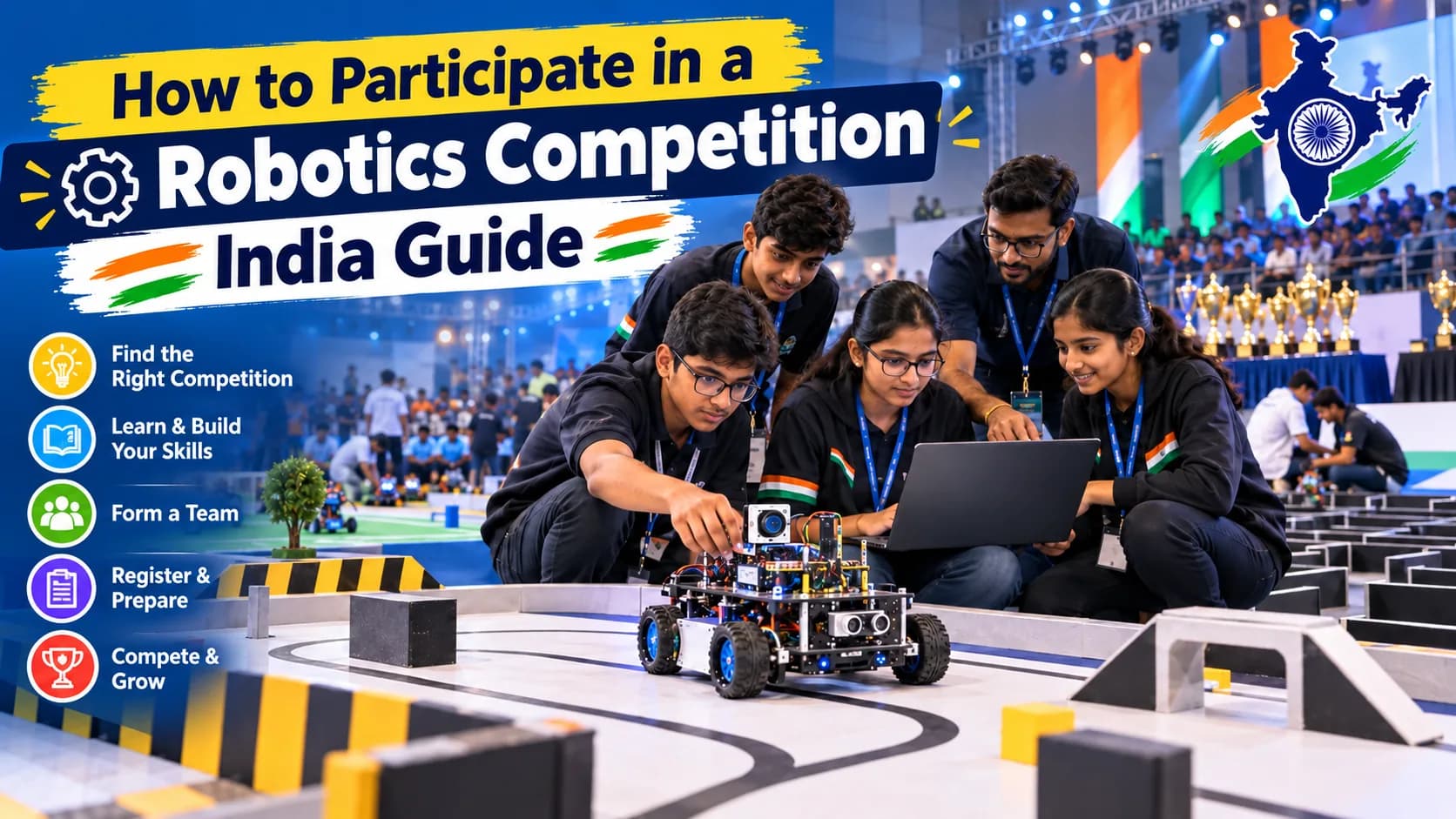
A robotics competition is where ideas come together. Students design, build, program, and test robots to play a specific game or perform a certain task. From line-following to robotic soccer, events welcome school students, engineering students, newcomers, and experienced competitors.
But how do you find the right competition? What are the registration and preparation steps? How much does it cost to participate? And what should you bring on the event day?
This article will explain how to participate in a robotics competition in India, what to consider while preparing your robot, and how to avoid common mistakes. We will also introduce you to two upcoming events organized by Robotic Sir AI India Pvt. Ltd.:
Robo Goal India 2026 – a live robotic soccer championship, and
Innovation India 2026 – a school student innovation competition.
What Is a Robotics Competition?
A robotics competition is an event where a robot or a team of robots must accomplish a given task. According to the competition rules, robots can score points, follow a track, navigate a maze, push each other, recognize objects, or perform specific actions.
Judges score teams and robots based on:
- Task accomplishment,
- Speed and accuracy,
- Robot design,
- Programming and autonomous functionality,
- Innovation,
- Teamwork,
- Safety, and
- Technical presentation. A robotics competition is a great way to learn. It is always an engineering challenge, where every connection, programming line, and design detail can be improved.
How Are Robotics Competitions Structured?
Every competition is different, but most of them have a similar flow:
- Registration,
- Preparation,
- Robot inspection,
- Qualification rounds,
- Knockout / semifinals,
- Final round,
- Results announcement. After you register, you will get the event rules and build your robot according to the guidelines. You may also need to bring your robot for inspection on the day of the event. Then, you will compete in qualification matches and progress to the final rounds.
Types of Robotics Competitions
There are many types of robotics competitions in India.
Some of the most popular are:
- Robotic soccer: score goals using your robot,
- Line-following: make your robot follow a line,
- Sumo: push your opponent's robot out of the arena,
- Maze and obstacle competitions: navigate your robot through a maze or around obstacles,
- Autonomous competitions: make your robot perform specific tasks,
- Drone and rover competitions: fly and drive your drone or rover through a course,
- AI and robotics: let your robot identify and sort objects,
- Innovation competitions: come up with a solution for a particular task, and
- Hardware competitions: build a working prototype or suggest a feasible hardware idea.
Who Can Participate in a Robotics Competition?
Most competitions have age, grade, and experience categories. School students and college students can register in separate divisions.
School Students
Most beginner-friendly competitions welcome school students. Age and grade requirements vary, but many events are open to anyone in classes 5 to 12.
Students can use line-following robots, robotic soccer, or innovation competitions to learn science, math, electronics, and programming.
College Students
Engineering and computer science students can participate in advanced robotics competitions.
They include drone, AI, and autonomous competitions, where robots must perform various tasks. Such challenges also help students build a portfolio and gain experience for internships and jobs.
Beginners
Are you new to robotics competitions? It is totally fine! Your first competition does not have to be the hardest one. Pick an easy challenge, understand how one robot works, and practice often. It is better to have a simple and reliable robot than to build an exciting but defective machine.
How to Find a Robotics Competition in India
Robotic competitions are usually announced by organizations, colleges, and companies. School students can look for events in their area or at their college fests. You can also search on social media, robotics forums, or competition websites.
Never register for a competition based solely on a social media post. Always visit the event registration page and review the rules, venue, date, and contact information.
Things to Consider Beforehand
| Criteria | Details |
|---|---|
| Eligibility | Age, class, academic qualification, or category |
| Team size | Individual or group |
| Location | City or venue |
| Date | Reporting time and competition day |
| Fee | Registration cost and additional expenses |
| Robot | Size, weight, or technical requirements |
| Rules | Technical and competition rules |
| Prize | Money, awards, certificates, or judging criteria |
| Deadline | Registration and project submission |
How to Choose the Right Robotics Competition
How to Choose the Right Robotics Competition
Choose Based on Your Experience
Beginners: pick a line-following, obstacle-avoiding, robotic soccer, or innovation challenge.
Intermediate: try sensor-based autonomous robots, maze competitions, or robotic soccer.
Advanced: participate in AI and computer vision, drone, or advanced autonomous competitions.
Choose Based on Your Interests
If you enjoy programming more than building robots – sign up for an autonomous competition. If you love to work with your hands – join a sumo or robot-building contest. If you have an innovative idea – compete in a hardware or innovation competition. If you want to challenge yourself – try a drone competition.
The competition should be fun and engaging. It should also help you learn new skills and gain experience.
How to Register for a Robotics Competition
Overview of the registration process:
- Check eligibility: make sure you qualify for the event.
- Study the rules: go over the robot specs, scoring system, restrictions, and safety rules.
- Assemble your team: pick team members with different skill sets.
- Register: fill out the application form with correct information. Double-check the details before submitting the form.
- Pay the fee: if applicable, pay the registration fee and save the receipt.
- Confirm your spot: ensure that you received a confirmation email, message, or call from the organizers.
How to Prepare for a Robotics Competition
Understand the Rules
Make a cheat sheet with the most important rules and robot specs. Keep it simple: write down the maximum size and weight, allowed motor types, recommended sensors, battery voltage, and other guidelines. Always build your robot according to the rules.
Design Your Robot
Sketch your robot design and write a list of required components. Base your design on the competition rules and arena size. Think about the robot body, wheels, and motor types. Use a microcontroller (Arduino, ESP32), motor driver, and other technical hardware. Remember to leave space for essential components.
Build Your Robot
Always assemble your robot in a well-ventilated area. Avoid working in damp or smoky conditions. Soldering can be dangerous, so double-check the soldering iron temperature. Secure all components and wires, and make it easy to reach the battery, motor, and other crucial parts.
Program Your Robot
Use Arduino or C++ to code your robot. Break the code into multiple functions and test every part of your robot. Make sure that it moves forward and backward, turns left and right, avoids obstacles, and stops when needed.
For autonomous robots, test the "decision-making" code under different conditions.
Save the working code as a backup: never make changes to it.
Test Your Robot
It is critical to test your robot before the competition. Test it several times in different conditions.
Check the following functions:
- Forward and backward movement,
- Left and right rotation,
- Sensor response,
- Communication,
- Battery endurance,
- Software stability,
- Wheel alignment,
- Mechanical robustness,
- Emergency stop. Write down all the issues and bugs you encounter. Save the log to ensure that your robot works correctly before the competition.
Practice Competing
Set up a competition arena and practice under the same conditions as the event day. Follow the time limits and scoring rules to prepare for the real match. You can also use a smaller battery to simulate low-power conditions or ask a friend to be your tester. Practice is the best way to spot potential issues.
What Skills Do You Need for a Robotics Competition?
A robotics competition is challenging, but you do not have to be an expert in all areas. The most important skills are:
- Programming,
- Electronics,
- Mechanical building,
- Robotics,
- Teamwork,
- Problem-solving,
- Communication. If you are not confident about one skill, partner with someone stronger in that area. A good team member should be able to handle basic troubleshooting and explain the technical details to other teammates.
What Equipment Do You Need?
Robotics competitions require different types of equipment:
| Robot Components | Common Examples | Restrictions |
|---|---|---|
| Microcontroller | Microcontrollers | Allowed and disallowed microcontrollers |
| Motors and Wheel types | Wheel diameter and type | |
| Motor Driver | Motor driver ICs | Allowed and disallowed motor drivers |
| Sensors | Sensors | Allowed and disallowed sensors |
| Battery | Battery voltage and type | Battery capacity |
| Switch | Switch type and location | |
| Chassis | Chassis size and material | |
| Wires and Connectors | Recommended wires and connectors |
Tools and Support Equipment
Make sure to bring the necessary tools, such as screwdrivers, pliers, a multimeter, a programming cable, a laptop, electrical tape, and cable ties.
Soldering equipment should only be used in the venue if it is allowed and you follow all safety instructions.
How Much Does It Cost to Participate?
The cost varies depending on the competition rules, but there are usually two types of expenses:
- Registration fee: most competitions have a small fee per student or team.
- Robot building: it depends on whether you have to buy parts or can use old components. Other expenses include travel, hotel, food, and spares. You should also set aside some money for last-minute purchases. It is always a good idea to save extra cash for emergencies.
What to Bring to a Robotics Competition
| Robot Checklist | Documents | Personal Belongings |
|---|---|---|
| Complete robot | Robot batteries | Controller or remote |
| Spare motors | Robot cables | Replacement sensors |
| Programming cable | Tools | Registration confirmation |
| Student ID | Team details | Payment receipt |
| Phone charger | Power bank | Water bottle |
| Snacks | Notebook and pen |
Remember to mark your robot tools and spares so that you can find them easily.
What Happens on the Day of the Competition?
Day-of-event flow:
- Arrival,
- Document verification and inspection,
- Practice rounds,
- Qualification matches,
- Knockout or semifinals,
- Final round,
- Prize distribution. Most competitions have a short practice round, but it is best to come early and understand the rules clearly. During the inspection, event managers may ask to measure the robot's size, weight, and power supply. If your robot does not meet the requirements, ask for advice on what you can change.
10 Tips for Your First Robotics Competition
- Study the rules before designing your robot,
- Start preparing early,
- Make your robot simple and easy to fix,
- Learn the scoring system,
- Practice on different surfaces,
- Follow the time limits,
- Bring spares and tools,
- Teach teammates how to troubleshoot,
- Arrive early at the venue,
- Stay calm and fix problems one by one.
Common Mistakes Students Make
Avoid these common mistakes while preparing for a competition:
| Mistake | Explanation |
|---|---|
| Building a robot before studying the rules | The rules define the robot size and specify what components are allowed or disallowed. |
| Making your robot too complicated | Extra features add complexity and points of failure. |
| Not practicing enough | One successful test is not enough. You need to ensure that your robot works reliably under different conditions. |
| Not considering the battery voltage | Motor speed and sensor performance may change as the battery drains. |
| Forgetting to bring spares | A small problem, such as a dead battery or broken wire, can ruin your match. |
| Only one team member knows how to fix the robot | If they get injured or sick, your team will have to modify the robot without their help. |
| Practicing only under ideal conditions | Surfaces, lighting, and other conditions may be different at the venue. |
| Arriving late at the venue | You may miss the inspection and qualification rounds. |
Can a Beginner's Team Win a Robotics Competition?
Beginner teams can win, but it should not be their primary goal. Experience, preparation, and knowledge matter more than skill level in most cases. A team of newcomers with a decent robot, sound strategy, and real-life experience may beat an experienced team with a fancy but unreliable robot.
Even if your team does not win, the competition will be an invaluable learning experience. You will learn how to build and modify a robot under pressure, and the experience will help you in the future competitions.
Upcoming Robotics Competitions in India
If you are looking for a live robotic competition in India, Robotic Sir is organizing two exciting events this year:
Robo Goal India 2026
Robo Goal India 2026 is a live robotic soccer championship, where teams will compete in 1-vs-1 and 3-vs-3 matches. Robotic Sir AI India Pvt. Ltd. will host the event on 27th September 2026. You can take a workshop on how to build a soccer bot on 20th September.
Details
| Item | Detail |
|---|---|
| Championship date and time | 27 Sept 2026, 9:30 AM |
| Team size | 1 – 3 members |
| Robot category | Self-built |
| Format | 1-vs-1 qualifying matches, 3-vs-3 championship |
| Registration fee | ₹2,500 (per team) |
| Last day to register | 16 Sept 2026, 11:59 PM |
| Optional practice workshop | 20 Sept 2026 |
| Official practice day | 26 Sept 2026 |
| Awards | Cash prizes, trophies, certificates, and robotics goodies |
Register for Robo Goal India 2026
Innovation India 2026
Innovation India 2026 is a national-level hardware innovation competition for school students.
Details
| Item | Detail |
|---|---|
| Competition date | 26 Sept 2026 |
| Eligibility | School students, age 13 – 18 |
| Team size | Solo or team of 5 students |
| Submission deadline | 22 Sept 2026, 11:59 PM |
| Shortlist announcement | 24 Sept 2026 |
| Tracks | Hardware prototype or hardware idea with a pitch deck |
| Qualification rules | Not applicable |
| Prize | Money and awards |
| Location | Dome Area, Spectrum Metro Mall, Phase 2, Sector 75, Noida |
| Registration fee | Free of cost |
| Event language | English |
| Awards | Trophies, gifts, and special recognition for the best projects |
Register for Innovation India 2026
The rules, dates, and venue may change, so make sure to confirm the details before registering for the event.
Why You Should Participate in Robotics Competitions
Robotics competitions are a great way to gain real-world experience. They challenge your engineering and programming skills and teach you how to work in a team. Here are some of the benefits of participating in a robotics competition:
- Valuable engineering and programming experience,
- Enhanced problem-solving skills,
- Opportunity to work with others,
- Confidence in public speaking and presentations,
- Inspiration from other students and mentors,
- Real-world knowledge of technical limitations,
- Projects to include in your portfolio, and
- Chance to improve after each event. Your competition robot may only last for one event, but the knowledge and skills you gain will stay with you for a lifetime.
Frequently Asked Questions
How can I participate in a robotics competition? Find a desirable event, study the rules, prepare your robot, assemble your team, and register.
Can school students participate? Yes, school students can participate in most competitions.
Can beginners participate? Yes, but it is better to start with an easy robotics competition.
Do I need to know how to program? It depends on the event. Some competitions, like manual robotic soccer, do not require programming, while others, like autonomous competitions, are code-based.
Do I need to build my own robot? It depends on the competition rules.
How much does it cost to participate? It depends on the event. Some competitions are free, while others have a small registration fee. You may also have to pay for travel, accommodation, and robot parts.
How can I find upcoming robotics competitions in India? You can find upcoming robotics competitions on the websites of universities, robotics organizations, competition sites, and social media.
What should I bring to the venue? Bring your robot, robot batteries, controller, programming tools and equipment, tools, spares, student ID, and registration receipt.
How to Join a Robotics Competition in India
Your first robot does not have to be something fancy. It has to be safe, legal, understandable, and reliable. The best way to get started is to learn, build, test, compete, and improve. Whether you want to join the Robotic Soccer Championship or the School Student Innovation Competition, every step will bring you closer to your goal.
Browse all upcoming robotics competitions to find the right event for you.