
Robotic Sir Blog
The Future of Semiconductors: 10 Technologies That Will Transform the Next Five Years
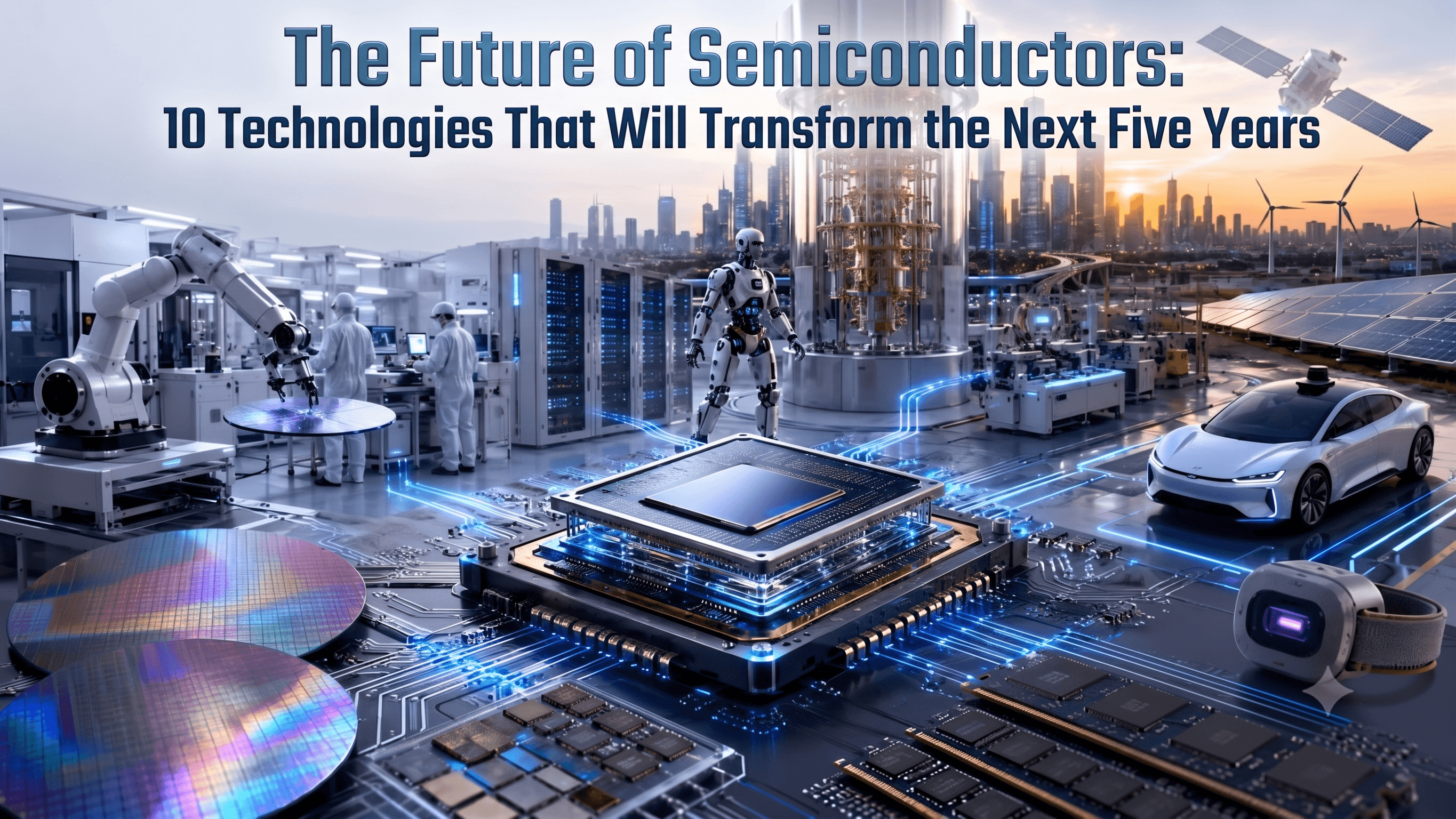
Imagine waking up in 2031. Your car notices a cyclist before you do. Your phone runs a powerful AI assistant without constantly sending information to the cloud. A small medical sensor detects an unusual health pattern and alerts you early. Robots work beside humans in factories, warehouses, hospitals, and farms.
These technologies may appear unrelated, but they all depend on the same invisible foundation: semiconductors.
Semiconductors are often called the "brains" of modern electronics. However, that description is becoming too limited. Chips are now becoming the eyes, ears, memory, communication system, and decision-making engine of the digital world.
The next five years will therefore be about much more than making smartphones faster. The semiconductor industry will influence artificial intelligence, electric vehicles, robotics, renewable energy, healthcare, national security, and even the way countries compete economically.
So, what will the future of semiconductors actually look like between 2026 and 2031? The answer begins with a major change in how the industry thinks about progress.
The Semiconductor Industry Is Entering a New Era
For decades, chip development followed a fairly predictable formula: make transistors smaller, place more of them on a chip, and improve performance. That approach is not disappearing, but it is becoming increasingly difficult and expensive.
At extremely small scales, engineers face problems involving heat, power leakage, manufacturing complexity, and the laws of physics. Building a leading-edge semiconductor factory can also require enormous investment, advanced machinery, and years of preparation.
Yet demand continues to grow. Artificial intelligence models require extraordinary computing power. Electric vehicles need hundreds or even thousands of chips. Smart factories depend on sensors and controllers, while data centres need processors, memory, and networking hardware operating together.
The industry's response will not be one miraculous invention. Instead, the future will be built through several technologies working together: smaller transistors, smarter architectures, advanced packaging, new materials, and highly specialized processors.
1. Artificial Intelligence Will Become the Industry's Main Growth Engine
The AI revolution is also a semiconductor revolution. Training and running modern AI systems requires huge numbers of calculations. Traditional general-purpose processors can handle many tasks, but they are not always efficient enough for large AI workloads.
This has created rapid demand for graphics processing units, neural processing units, AI accelerators, and custom silicon. Over the next five years, AI chips will become more specialized. Different processors will be designed for different jobs, including:
- Training large AI models in data centres
- Running AI assistants on smartphones and laptops
- Processing information inside autonomous machines
- Recognizing images and voices at the edge
- Controlling industrial robots in real time
- Supporting medical and scientific research Large cloud companies are already developing custom chips because they want better control over speed, energy consumption, and operating costs. This trend will accelerate as businesses discover that one chip architecture cannot efficiently handle every type of AI workload.
However, performance will not be the only priority. Energy efficiency will become equally important. The International Energy Agency expects global data-centre electricity consumption to more than double to approximately 945 terawatt-hours by 2030, with AI serving as the most important driver of that growth.
This means the winning AI chips will not simply be the fastest — they will deliver more useful computing for every watt of electricity consumed.
Source: International Energy Agency
2. AI Will Move from the Cloud into Everyday Devices
Today, many AI services rely heavily on remote data centres. You send a request over the internet, servers process it, and the result returns to your device. In the coming years, more of that intelligence will operate locally.
This development is known as edge AI or on-device AI. It allows a device to process information near the place where it is collected instead of transferring everything to the cloud. Future smartphones, cameras, robots, vehicles, and household devices will include dedicated AI processors capable of performing complex tasks independently.
Why does this matter?
- Latency — local processing reduces delay. A factory robot or vehicle cannot always wait for a distant server before making an important decision.
- Privacy — it can improve privacy because sensitive audio, images, or health information may remain on the device.
- Reliability — it reduces dependence on a continuous internet connection. By 2031, AI processors may become as normal in electronic devices as Wi-Fi and Bluetooth chips are today. The most useful AI may not always live inside a giant data centre — it may quietly operate inside the objects around us.
3. The 2nm Generation Will Bring Smaller and More Efficient Chips
The movement toward smaller semiconductor manufacturing nodes will continue, with 2-nanometre-class technologies becoming increasingly important. TSMC states that its N2 technology entered volume production in the fourth quarter of 2025. The process uses nanosheet transistors, a major architectural change from the FinFET designs that have powered several previous generations of advanced chips.
Source: TSMC 2nm Technology
A smaller process node does not mean that every physical feature measures exactly two nanometres — modern node names mainly represent a generation of manufacturing technology. Nevertheless, newer nodes can offer meaningful improvements in performance, transistor density, and power efficiency.
During the next five years, 2nm and related technologies are expected to appear in:
- Premium smartphones
- AI accelerators
- High-performance computers
- Advanced automotive systems
- Cloud servers
- Scientific computing platforms The transition will be gradual because leading-edge manufacturing is costly. Many products will continue using mature process nodes such as 28nm, 40nm, or 65nm when those technologies provide the right balance of cost, reliability, and availability. A simple sensor controller does not need the same chip technology as an advanced AI processor.
In the semiconductor industry, "newer" does not automatically mean "better for every application."
4. High-NA EUV Will Push Chip Manufacturing Further
Producing extremely small chip features requires some of the most advanced equipment ever constructed. Extreme ultraviolet lithography, or EUV, uses very short-wavelength light to print tiny patterns onto silicon wafers.
The next stage is High Numerical Aperture EUV, commonly called High-NA EUV. This technology is designed to print smaller features with greater precision, potentially reducing the need for some complicated multi-patterning steps.
ASML reported a major milestone in 2025 when it demonstrated a 1,000-watt EUV light source. In 2026, the company also announced further High-NA EUV production-readiness progress involving Intel's 18A technology.
Source: ASML Annual Report, ASML High-NA EUV Update
High-NA EUV systems are extraordinarily complex and expensive. Their adoption will therefore be selective rather than immediate. Even so, they could play an important role in manufacturing future generations of high-performance processors.
The fascinating part is that semiconductor progress now depends as much on advanced optics, materials science, and precision engineering as it does on traditional electronics.
5. Chiplets Will Replace the "One Giant Chip" Mindset
For many years, designers tried to place every major function onto one large piece of silicon. That strategy is becoming less practical. Large chips are difficult and expensive to manufacture — if a tiny defect appears in the wrong location, the entire chip may become unusable. Different functions may also perform best when produced with different manufacturing processes.
Chiplets offer another approach. Instead of creating one enormous chip, engineers divide the system into smaller functional pieces. One chiplet may handle computing, another may manage input and output, and another may provide specialized AI processing. These pieces are then connected inside one package.
Think of it like building a high-performance team — each member performs a specialized role, but they work together as one system.
Chiplets can provide several advantages:
- Better manufacturing yields
- More flexible product design
- Easier customization
- Reuse of proven components
- Potentially lower development costs
- The ability to combine different process technologies The long-term goal is greater interoperability. If common connection standards mature, companies may eventually combine compatible chiplets from different suppliers — creating a semiconductor ecosystem resembling modular construction rather than traditional monolithic design.
6. Advanced Packaging Will Become as Important as Transistor Size
A chip's package was once treated mainly as a protective shell. That idea is now outdated. Modern packaging determines how processors, memory, and chiplets communicate. It influences bandwidth, power delivery, heat removal, and overall system performance.
Technologies such as 2.5D packaging, 3D stacking, and hybrid bonding allow semiconductor components to be placed beside or on top of one another. Shorter connections can transfer data more quickly while using less energy than signals travelling across a conventional circuit board. This is especially valuable for AI systems, where processors constantly exchange huge amounts of data with high-bandwidth memory.
During the next five years, some of the industry's most meaningful performance improvements may happen inside the package rather than inside an individual transistor.
However, placing powerful components closer together also concentrates heat. Future packages will therefore require improved cooling materials, thermal design, power management, and possibly liquid-cooling solutions.
The future of chip engineering will not only be about fitting more transistors onto silicon — it will also be about connecting and cooling those transistors intelligently.
7. Memory Will Become a Strategic Part of AI Computing
AI processors receive much of the attention, but an accelerator cannot work efficiently if data cannot reach it fast enough. This is why memory technology — particularly high-bandwidth memory, or HBM — has become critical.
HBM stacks multiple layers of memory and places them close to the processor. This architecture can provide much higher data-transfer capacity than conventional memory arrangements.
Over the next five years, semiconductor companies will focus heavily on:
- Higher HBM capacity
- Faster memory interfaces
- Improved 3D stacking
- Lower power consumption
- Better processor-to-memory communication
- New approaches to computing closer to stored data Researchers are also exploring in-memory computing, where certain calculations happen inside or near the memory itself. This could reduce the constant movement of data between processor and memory — one of the largest sources of energy consumption in computing systems.
The next AI breakthrough may therefore depend as much on memory innovation as on processor speed.
8. Electric Vehicles Will Drive Demand for Power Semiconductors
Not every important semiconductor needs to be produced with the smallest process node. Electric vehicles, charging stations, solar inverters, industrial motors, and renewable-energy systems require components that can safely control high voltage and current.
For these applications, materials such as silicon carbide and gallium nitride are increasingly valuable. Silicon carbide devices can operate efficiently at high temperatures and voltages, making them useful in electric-vehicle powertrains and fast-charging infrastructure. Gallium nitride devices can switch rapidly with relatively low energy loss, which makes them attractive for compact chargers, power supplies, and certain communication applications.
During the next five years, improvements in power semiconductors could produce:
- Smaller and lighter chargers
- More efficient electric vehicles
- Reduced energy loss
- Better renewable-energy conversion
- More compact industrial equipment
- Improved power systems for data centres These components may not receive the same attention as headline-making AI processors, but they will be essential to electrification.
9. Cars Will Become Semiconductor Platforms on Wheels
Modern vehicles are already filled with electronics. By 2031, the connection between automobiles and semiconductors will be even stronger.
Advanced vehicles require chips for battery management, motor control, cameras, radar, infotainment, connectivity, safety systems, and driver assistance. At the same time, manufacturers are moving away from dozens of isolated electronic control units toward more centralized computing architectures. Powerful domain controllers may manage several vehicle functions through software.
This transition could make vehicles easier to update and improve after purchase. It also increases the importance of cybersecurity and long-term chip reliability.
Automotive semiconductors face requirements that consumer electronics often do not. A phone processor may be replaced after a few years, but an automotive chip may need to operate safely through temperature changes, vibration, and a much longer product life.
The future car will not simply contain more chips — it will increasingly be designed around them.
10. Semiconductor Supply Chains Will Become More Regional
The global chip shortage exposed how dependent the world had become on a small number of manufacturing regions and suppliers. In response, governments and companies are investing in new fabrication facilities, packaging plants, research centres, and workforce-development programs.
The United States, European Union, Japan, India, South Korea, and other economies want stronger domestic or regional semiconductor capabilities. Yet complete independence is unlikely. A single advanced chip may depend on design software from one country, manufacturing equipment from another, wafers produced elsewhere, fabrication in a different region, and packaging in yet another location. The semiconductor supply chain is too specialized to be easily recreated within one national border.
Therefore, the next five years will probably bring diversification rather than total separation. More countries will gain parts of the semiconductor value chain, while international partnerships remain essential.
India, for example, has an opportunity to expand beyond its existing strengths in engineering and chip design. Growth in fabrication, assembly, testing, packaging, and compound semiconductors could create new employment and help the country develop a broader electronics-manufacturing ecosystem.
Sustainability Will Become a Serious Engineering Challenge
Semiconductor fabrication requires substantial energy, ultra-pure water, specialized chemicals, and complex equipment. As chip production expands, its environmental impact will receive greater attention.
The industry will face pressure to:
- Recycle more water
- Reduce greenhouse-gas emissions
- Use renewable electricity
- Improve material efficiency
- Extend product lifetimes
- Design chips that consume less power There is an important contradiction at the centre of the semiconductor future. Chips can make vehicles, buildings, factories, and electricity grids more efficient, but manufacturing and operating those chips also consumes resources.
Solving this problem will require a life-cycle approach. A processor should not be judged only by its peak performance — engineers will increasingly examine how much energy it consumes, how long it remains useful, and how efficiently it can complete a real task.
What About Quantum and Neuromorphic Chips?
Quantum computing often appears in discussions about the future of semiconductors, but it is unlikely to replace ordinary computers within the next five years. Instead, quantum processors may gradually become useful for selected problems in areas such as chemistry, materials research, and optimization. They will most likely operate alongside classical semiconductor systems rather than replacing them.
Neuromorphic computing is another promising field. Neuromorphic chips attempt to process information using structures inspired by biological neural systems. They may be especially useful for low-power sensing, pattern recognition, and robotics.
Both technologies deserve attention, but expectations should remain realistic. Between 2026 and 2031, their greatest impact may occur in research laboratories and specialized commercial applications — not in every laptop or smartphone.
The Biggest Challenges Ahead
The future of semiconductors is exciting, but progress is not guaranteed. The industry must overcome several major obstacles:
Rising costs — advanced fabrication plants and manufacturing equipment require enormous investment. Only a small number of companies can compete at the leading edge.
Shortage of skilled professionals — the industry needs electrical engineers, materials scientists, equipment specialists, software developers, technicians, and packaging experts. Developing this workforce will take time.
Heat and energy consumption — as computing systems become more powerful, cooling and electricity requirements could limit their growth.
Supply-chain risk — natural disasters, trade restrictions, regional conflicts, or shortages of specialized materials can disrupt global production.
Increasing design complexity — combining chiplets, memory, software, and packaging creates more design and testing challenges. Hardware security will also become increasingly important.
These difficulties will not stop semiconductor innovation, but they will influence which technologies reach the market and how quickly they become affordable.
Skills That Will Matter in the Semiconductor Future
For students and young engineers, the semiconductor revolution will create opportunities far beyond traditional chip design. Important career areas will include:
- VLSI design and verification
- Embedded systems
- Robotics and automation
- Artificial intelligence hardware
- Semiconductor fabrication
- Materials science
- Advanced packaging
- Automotive electronics
- Power electronics
- Hardware cybersecurity
- Electronic design automation
- Thermal and cooling engineering A student does not need access to an advanced fabrication plant to begin. Learning digital electronics, microcontrollers, PCB design, C/C++, Python, FPGA development, and basic semiconductor physics can build a strong foundation.
The most valuable professionals will often be those who can connect multiple fields — for example, engineers who understand both AI software and hardware, or both robotics and embedded electronics.
Final Thoughts: The Next Five Years Will Be About Smarter Systems
The future of semiconductors will not be defined by one company, one country, or one manufacturing node. It will be shaped by an entire network of technologies.
Smaller transistors will continue to matter, but so will chiplets. AI accelerators will become faster, but memory and packaging will decide how effectively they perform. Electric vehicles will need powerful computers, but they will also depend on efficient silicon carbide and gallium nitride devices.
Most importantly, the semiconductor industry will move from chasing performance at any cost toward balancing performance, energy, affordability, security, and sustainability.
By 2031, chips will be present in more places, but they may become less visible. They will quietly manage traffic, balance electricity grids, assist doctors, power robots, and bring AI into ordinary devices.
That is the strange power of semiconductors: the smaller they become, the larger their influence grows.
The next five years will not simply produce a new generation of chips. They will produce a new generation of possibilities.
Frequently Asked Questions
What is the future of the semiconductor industry? The industry is expected to grow through demand from artificial intelligence, electric vehicles, data centres, robotics, renewable energy, and connected devices. Its future will combine smaller process nodes with chiplets, advanced packaging, and specialized processors.
Which semiconductor technology will grow the most? AI accelerators, high-bandwidth memory, advanced packaging, and power semiconductors are likely to experience particularly strong demand. Their growth will be driven by AI infrastructure, edge computing, and electrification.
Will 2nm chips be available within the next five years? Yes. TSMC began volume production of its N2 technology in late 2025, and 2nm-class chips are expected to become more common in premium and high-performance products during the following years.
Will quantum computers replace semiconductor chips? No. Quantum computers are expected to remain specialized systems during this period. They will rely on classical semiconductor hardware for control, storage, and communication.
Why are chiplets important? Chiplets allow designers to combine smaller, specialized components inside one package. This can improve flexibility, manufacturing yield, and system performance while reducing the need to create one very large chip.
Is the semiconductor field a good career choice? Yes. Growing demand for chips is creating opportunities in VLSI, embedded systems, AI hardware, fabrication, packaging, power electronics, automotive systems, and robotics.