
Robotic Sir Blog
The Future of Humanoids: How Gemini Robotics 2 & ROBOTIC SIR Are Shaping Next-Gen Tech
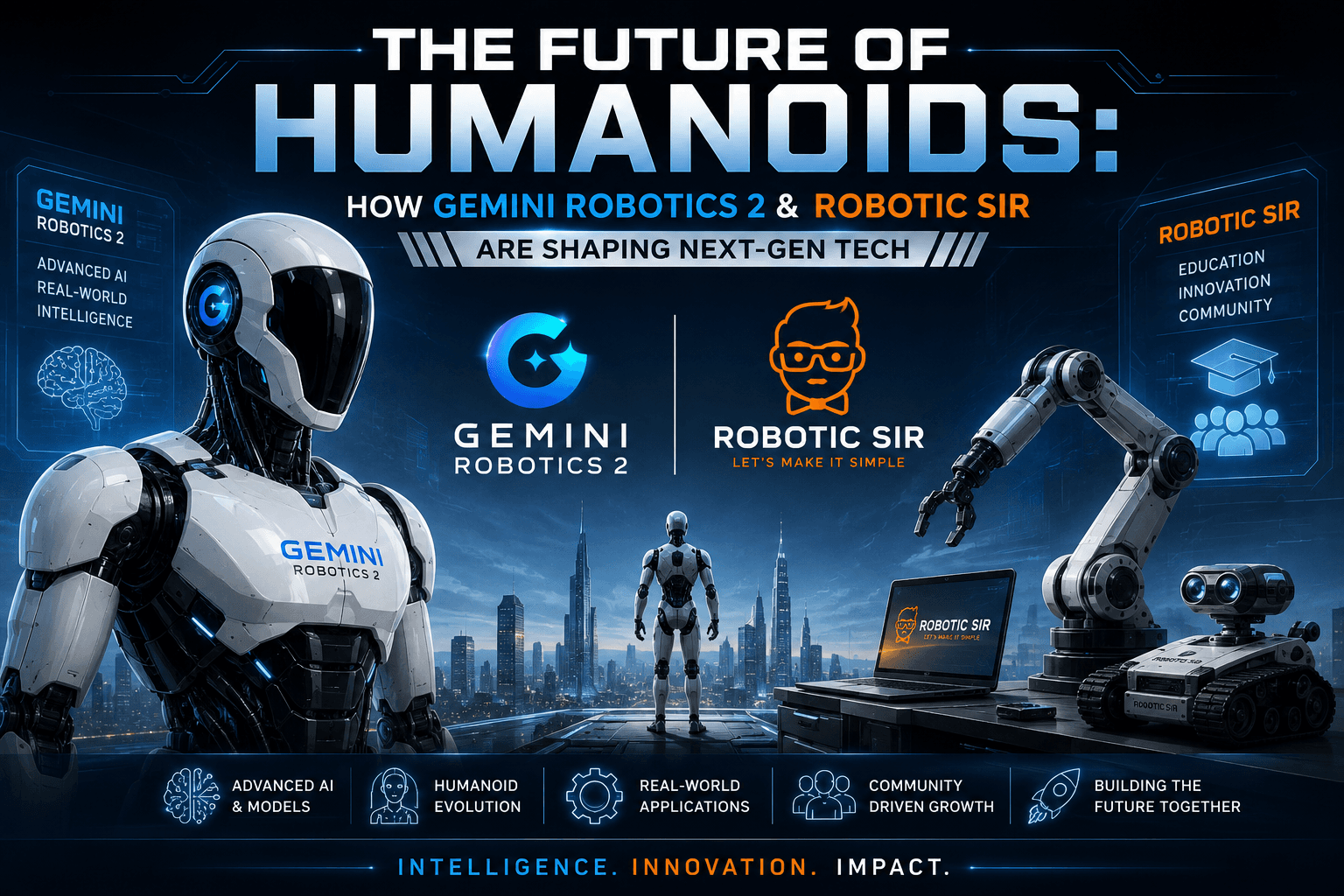
Robotics was based on a lie. We made hyper-intelligent language models that could write poetry in a split second. But ask a 200-pound piece of metal to crouch down, balance on an uneven floor, and unscrew a lightbulb without shattering the glass, and everything falls apart.
Why? Because traditional robotics had a fractured architecture:
- The High-Level Brain — guessers of how the world looks
- The Low-Level Motors — stiff, pre-programmed, blind controllers
Google DeepMind's new Gemini Robotics 2 just burned that playbook to the ground. We are not only giving robots "eyes and brains," but whole-body intelligence from feet to fingertips. At ROBOTICSIR, we live and breathe real-world robotic deployments, so this isn't just news — this is the roadmap for the next decade. Here's what you need to know.
1. Whole-Body Kinematics: The End of Big Brain, Stupid Body
In the past, a robot's vision model just paid attention to the hands, while a separate balance controller prevented the feet from tipping over. Gemini Robotics 2 integrates whole-body control into a single Vision-Language-Action (VLA) neural policy.
- Foot-to-Fingertip Coordination — Whether it's Apptronik's Apollo 2 humanoid bending over to pick up a tool from a bottom shelf or adjusting weight distribution on the fly, balance and manipulation are now calculated in the same loop.
- Hardware-Agnostic Adapters — Models trained on a range of hardware (from 22-DOF dexterity hands like the SharpaWave to industrial bi-arm grippers) can now adapt to completely new hardware bodies with fewer than 200 physical demonstration examples.
Foundation models give robots generic intuition, but real industrial workflows demand millimeter precision and zero downtime.
At ROBOTICSIR, we bridge this gap by taking raw VLA capabilities and customizing hardware control stacks for custom enterprise environments. Want to see how we tune robot controllers in the lab? Follow our build logs on Instagram: @roboticsir_official
2. Edge Latency & Embodied Reasoning (ER2)
If there's a 5-second delay on every action in the cloud for a robot that can move, it's useless. DeepMind solved this with a split architecture:
- Gemini Robotics ER 2 (The Tactician) — Powered by Gemini 3.5 Flash, this model is capable of multi-minute context windows, understanding live video streams continuously, and decomposing high-level goals into multi-agent task maps.
- On-Device 2 (The Reflexes) — Executes local VLA policies on the robot's on-board silicon for real-time motor adjustments, with no wait for internet bandwidth.
3. The Cold Hard Truth: Accuracy Is Still King
Let's get down to the marketing hype. ER 2 can reason through complex commands like "Clear this cluttered workspace with your teammate," but the ultimate test is physical dexterity.
- Dexterity success rates on benchmarks today range from 32% to 90%, depending on lighting, friction, and fragility of the object.
- Generic models still have trouble putting in small screws, fragile wire harnesses, or sealing flexible packages.
That's where hardware-aware engineering comes in.
Foundation AI gets the robot 80% of the way there; custom sensor integration and end-effector design finish the job.
Inside Our Robotics Lab
Weekly we run the latest physical AI models on real hardware — the breakthroughs, the fails, the unfiltered mechanics.
Live torque testing, custom gripper builds, and raw engineering teardowns on @roboticsir_official on Instagram!
From Research Labs to Real-World Robots: The Engineering Challenge Ahead
The next revolution in robotics won't be just about bigger AI models or more powerful processors. The real breakthrough will be the link between intelligence and physical capability. A humanoid robot could comprehend an instruction to "organize this workspace" or "help a human worker," but translating that comprehension into a safe, precise, repeatable motion takes years of engineering in sensors, actuators, control systems, and mechanical design.
Here lies the void that companies and robotics innovators such as ROBOTICSIR attempt to fill between AI research and practical robotic solutions. Foundation models equip robots with reasoning skills, but any real-world use needs customization. A warehouse robot, a healthcare assistant, an educational robot, or an industrial manipulator all work in different environments with unique challenges. The robot must learn not only what to do, but how to do it safely and efficiently.
ROBOTICSIR is building the future of robotics through a combination of AI intelligence, hardware innovation, and hands-on engineering. We are about exploring the possibilities of modern robotic platforms, custom automation solutions, and helping the next generation of engineers understand the technologies that shape the future. Whether it's robotic arms, autonomous systems, or AI-driven humanoid concepts, the key to making ideas into working machines is practical implementation.
Physical AI Education and Innovation Expansion
As humanoid robotics progresses, robotics education will be key to preparing future innovators. Tomorrow's engineers will need to be multi-disciplinary, knowing artificial intelligence, electronics, mechanical design, programming, computer vision, and embedded systems. Robotics education is no longer about building simple machines — it is about creating intelligent systems that can interact with the real world.
ROBOTICSIR is working toward creating a stronger robotics ecosystem where students, engineers, and technology enthusiasts can explore these emerging technologies through practical projects and real hardware experimentation. By combining theoretical knowledge with real-world implementation, learners can understand how concepts like AI vision, autonomous navigation, robotic manipulation, and human-machine interaction are developed.
The Road Ahead: Humans and Robots in the Loop
We do not need to replace humans with more humanoid robots; we need intelligent partners that can help people perform complex, repetitive, and dangerous activities. Future robots might help factory workers, care for seniors at home, or work alongside medical teams in environments that pose dangers to human beings.
That future is only realized with ongoing progress toward reliability, affordability, and flexibility. Getting from lab prototypes to everyday robotic assistants will rely on companies that can harness research in AI and combine it with engineering know-how. The age of humanoid robots has begun, and the companies building the bridge between AI and robotics will define a future class of technology.
Original story, ROBOTICSIR — We are dedicated to discovery, development and dissemination of this exciting journey into a robotic future.