
Robotic Sir Blog
Robotics Engineering in India: Scope, Salary, and Career Path
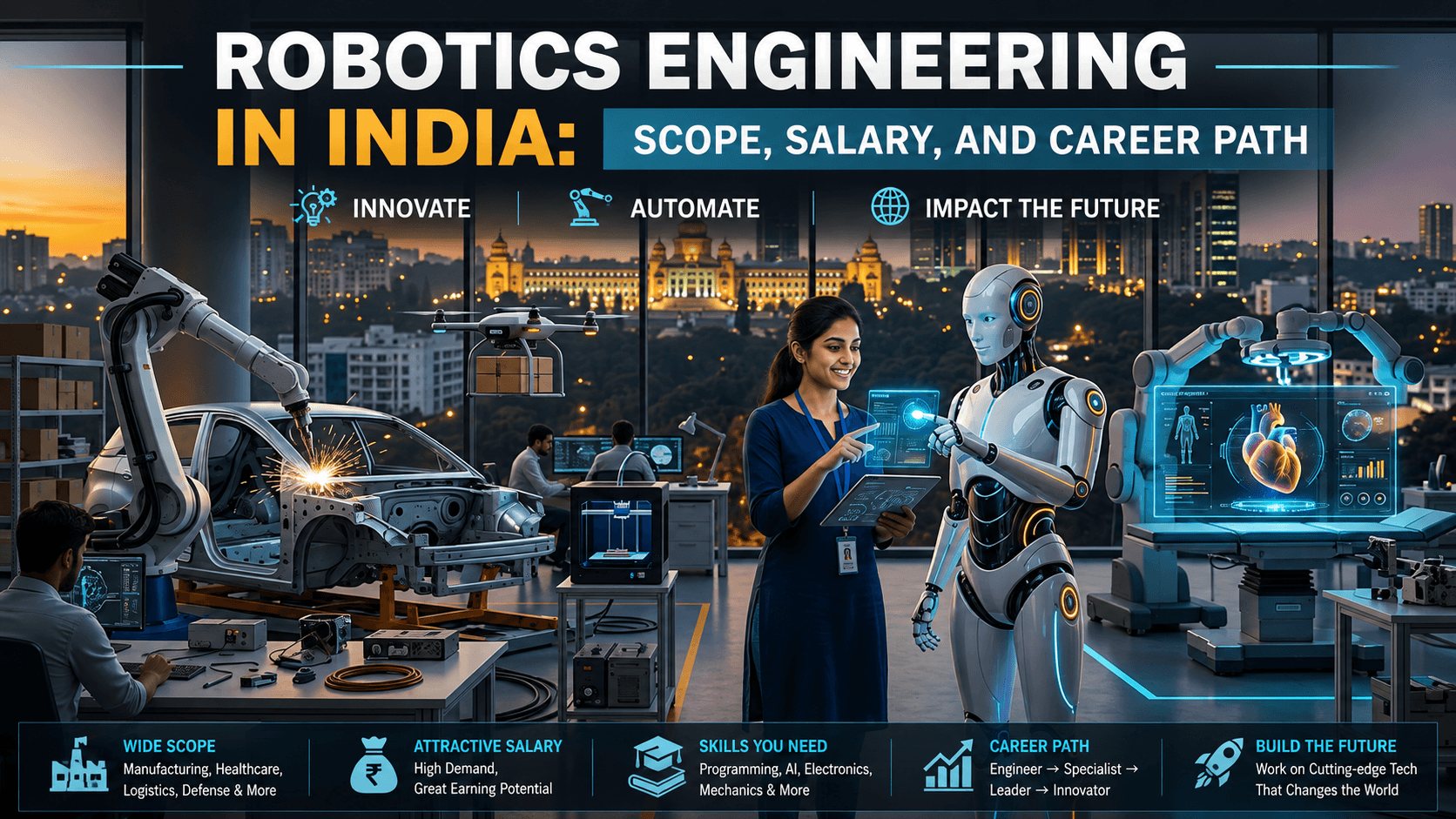
Imagine a warehouse where automated machines carry thousands of parcels, a factory where robots manufacture vehicles with amazing precision, and a hospital where robotic devices help doctors do complicated surgeries. This is the quickly developing field of robotics engineering, not science fiction.
Robotics is becoming one of the most fascinating engineering specialties for students and young professionals as India pushes toward automation, smart manufacturing, artificial intelligence (AI), and Industry 4.0.
But is a career in robotics engineering worthwhile in India? What is the true job of a robotics engineer? What is your earning potential? What abilities are necessary to work in this field?
Let's go over all you need to know about robotics engineering in India, including future prospects, career options, pay, education, and abilities.
Robotics Engineering: What Is It?
Robotics engineering is an interdisciplinary field that integrates mechanical engineering, electrical and electronics engineering, computer science, programming, artificial intelligence, and control systems in order to design, construct, program, and run robots.
A robot is more than just a moving machine. It must be able to sense its surroundings, absorb information, decide, and act. The experts who enable this are robotics engineers.
A robotics engineer might, for instance, work on:
- Manufacturing-related industrial robots
- Self-governing mobile robots
- Automation systems for warehouses
- Unmanned vehicles and drones
- Robots for medicine
- Robots for agriculture
- AI-driven robotic devices that resemble humans
To put it simply, robotics engineering uses a combination of hardware and software to make machines come to life.
Why Is India's Robotics Engineering Industry Expanding?
Automation is expanding quickly in India across a number of industries, including manufacturing, logistics, healthcare, agriculture, and defense.
Robotics is being used by businesses to boost accuracy, decrease tedious manual labor, raise production, and function effectively at scale.
Robots are becoming more capable than ever thanks to advancements in AI, machine learning, computer vision, sensors, and autonomous systems.
For students who are interested in both engineering and emerging technology, this is a significant opportunity.
India's Robotics Engineering Scope
In India, robotics engineering encompasses far more than just conventional manufacturing.
1. Automotive and Manufacturing
One of the largest applications of robotics is in factories. Welding, painting, assembling, inspection, packing, and material handling are all tasks that robots can complete. Industrial automation is particularly important in the manufacturing of automobiles.
2. Logistics and Storage
The need for automated warehouses has grown as e-commerce has expanded. Robots are capable of handling inventories, sorting shipments, transporting items, and helping employees with repetitive jobs.
3. Medical Robotics and Healthcare
Healthcare is also changing as a result of robotics. Robotic systems can help in patient care, surgery, rehabilitation, and diagnostics. Medical robotics is a significant field for future development even though it necessitates specific expertise and stringent safety regulations.
The thrilling part? Hardware and software are not always mutually exclusive — at the nexus of both is robotics.
4. Space and Defense
Applications for robotics exist in places where sending people could be risky or unfeasible. Examples of this expanding field include robotic exploration technology, autonomous vehicles, drones, and remotely operated devices.
5. Artificial Intelligence and Research
Robotics research can be very fascinating for students who enjoy experimenting. Researchers focus on topics like:
- Computer vision
- Self-sufficient navigation
- Human-robot interaction
- Reinforcement learning
- Humanoid robots
- Swarm robotics and robot perception
How to Work in India as a Robotics Engineer
Learning a single course is not enough to become a robotics engineer. Engineering principles, programming, hands-on experimentation, and problem-solving skills are all necessary.
This is how a typical professional path looks:
Class 10 → Class 12 with PCM → Engineering Degree → Robotics Projects/Internships → Specialized Skills → Robotics Employment or Further Education
Let's dissect it.
You can start your career in robotics at an early age while others are busy being bookworms, by joining ROBOTICSIR.
Step 1: Visit a ROBOTICSIR branch or enquire via social media, or just tap the link below. https://roboticsir.com/
Step 2: Establish a solid foundation in science and mathematics. Mathematics and physics are especially crucial. When dealing with robots, subjects like mechanics, electricity, calculus, vectors, probability, and statistics might be helpful. Although you don't have to be an expert mathematician, you should feel at ease with technical issues.
Step 3: Select the appropriate engineering degree. Students with a variety of engineering backgrounds can pursue robotics, such as:
- Mechanical engineering
- Robotics and automation engineering
- Electronics and communication engineering
- Electrical engineering
- Computer science engineering
- Mechatronics engineering
There are other options than a degree specifically in robotics — a lot of people who work in robotics start out in mechanical, electronics, electrical, or computer science engineering before specializing in robotics.
Step 4: Get programming knowledge. One of the most important robotics skills is programming. Typical robotics-related languages and technologies include:
- Python, C++, MATLAB
- ROS / ROS 2, Linux
- Frameworks for computer vision
- Tools for machine learning
You don't have to become an expert at everything at once. Learn the basics of programming in one language, then progressively advance to tools designed specifically for robots.
Step 5: Construct actual projects. This is the point at which robots get truly fascinating. Create something that moves, detects, or reacts — rather than just studying theory. For instance, you could make:
- A robot that follows lines
- A robot that avoids obstacles
- A robotic arm
- A prototype autonomous car
- A robot with computer vision
- An automation system for smart homes
Projects provide you with something very valuable: proof of your actual building abilities.
Step 6: Acquire experience in the field. You can learn about robotics outside of the classroom through internships, robotics contests, research projects, hackathons, and technical communities. These can also improve your resume when you apply for your first job.
Competencies Needed to Work as a Robotics Engineer
It takes more than just an engineering degree to be a successful robotics engineer.
Technical proficiency — you should progressively learn about:
- Programming and algorithms for robotics
- Actuators and sensors
- Electronic devices
- Mechanical systems
- Control systems
- Computer vision
- Artificial intelligence
- Embedded systems
- Operating systems for robots
Soft skills — robotics is another team sport, so communication and collaboration matter alongside the technical stack.
India's Robotics Engineer Salary
"How much does a robotics engineer earn in India?" is one of the most often-asked questions by students.
Experience, location, education, technical skills, firm, industry, and specialization are some of the variables that determine the response.
Entry-level pay — while entry-level salaries are usually the starting point for new hires, the precise pay can differ significantly between businesses and positions. A candidate with a solid portfolio, programming expertise, internship experience, and familiarity with contemporary robotics technologies can have an advantage over one with merely theoretical understanding.
Experience-based pay — professionals can advance into positions with more technical responsibility as they gain experience. Skilled experts may focus on fields like software for robotics, autonomous systems, robotics research, computer vision, AI/ML, controls, and industrial automation.
Prospects for Employment in Robotics Engineering
Because robotics is such a large field, there is no one right path for your career. Here are a few well-liked career choices:
Robotics Engineer Robotic systems are designed, developed, tested, and maintained by robotics engineers. They might work in programming, electronics, control systems, mechanical design, or system integration.
Robotics Software Engineer The software aspect of robots is the primary focus of this position. Experts may create algorithms for motion planning, navigation, vision, robot control, and autonomous decision-making.
Automation Engineer Automation engineers focus on systems that minimize human participation in commercial and industrial processes — including PLCs, industrial robots, sensors, control systems, and automated manufacturing lines.
Computer Vision Engineer How can a robot "see"? Computer vision engineers create systems that enable machines to comprehend images and video. Applications include autonomous systems, facial recognition, navigation, item detection, and inspection.
Robotics Researcher Research can be the best course of action if you appreciate tackling problems that don't currently have simple solutions. Robotics researchers may pursue master's or doctoral degrees while working on cutting-edge technologies.
AI and Machine Learning Engineer Robotics and AI together are creating new opportunities for autonomous machines. Experts in this field can work on intelligent robot behavior, learning systems, perception, prediction, and decision-making.
Frequently Asked Questions
What is robotics engineering? The design, development, programming, and control of robots and autonomous systems are all part of the multidisciplinary area of robotics engineering.
Is a career in robotics engineering worthwhile in India? Indeed. For students interested in engineering, programming, artificial intelligence, automation, and future technologies, it can be a lucrative career.
How much does an Indian robotics engineer make? Experience, skills, expertise, employer, and geography all affect salary. Experienced professionals can command much higher salaries, whereas new hires typically start at entry-level.
For robotics engineering, what degree is ideal? Pathways into robotics can be found in robotics and automation, mechatronics, mechanical, electrical, electronic, and computer science engineering.
Does robotics require coding? Indeed, programming is a crucial robotics skill, especially for computer vision, AI, autonomous systems, and robotics software.
What prospects does robotics engineering have in India going forward? Manufacturing, logistics, healthcare, agriculture, defense, aerospace, research, and AI-powered autonomous systems are all areas where the discipline has promise.
Conclusion
Building machines is only one aspect of robotics engineering. It involves building systems that are able to perceive, think, move, learn, and engage with their surroundings.
The topic presents an intriguing nexus of automation, programming, electronics, mechanical engineering, and artificial intelligence for Indian students. The career path may be difficult, but that's precisely what makes it fascinating.
If you start developing practical skills today — rather than waiting until your final year — you can put yourself in a much stronger position for the robotics jobs of tomorrow.
The robots may be getting smarter. The engineers building them need to be smarter too.