
Robotic Sir Blog
Pudu Robotics Brings Its Robot Workforce to Europe: From the D7 Semi-Humanoid to Delivery and Cleaning Robots
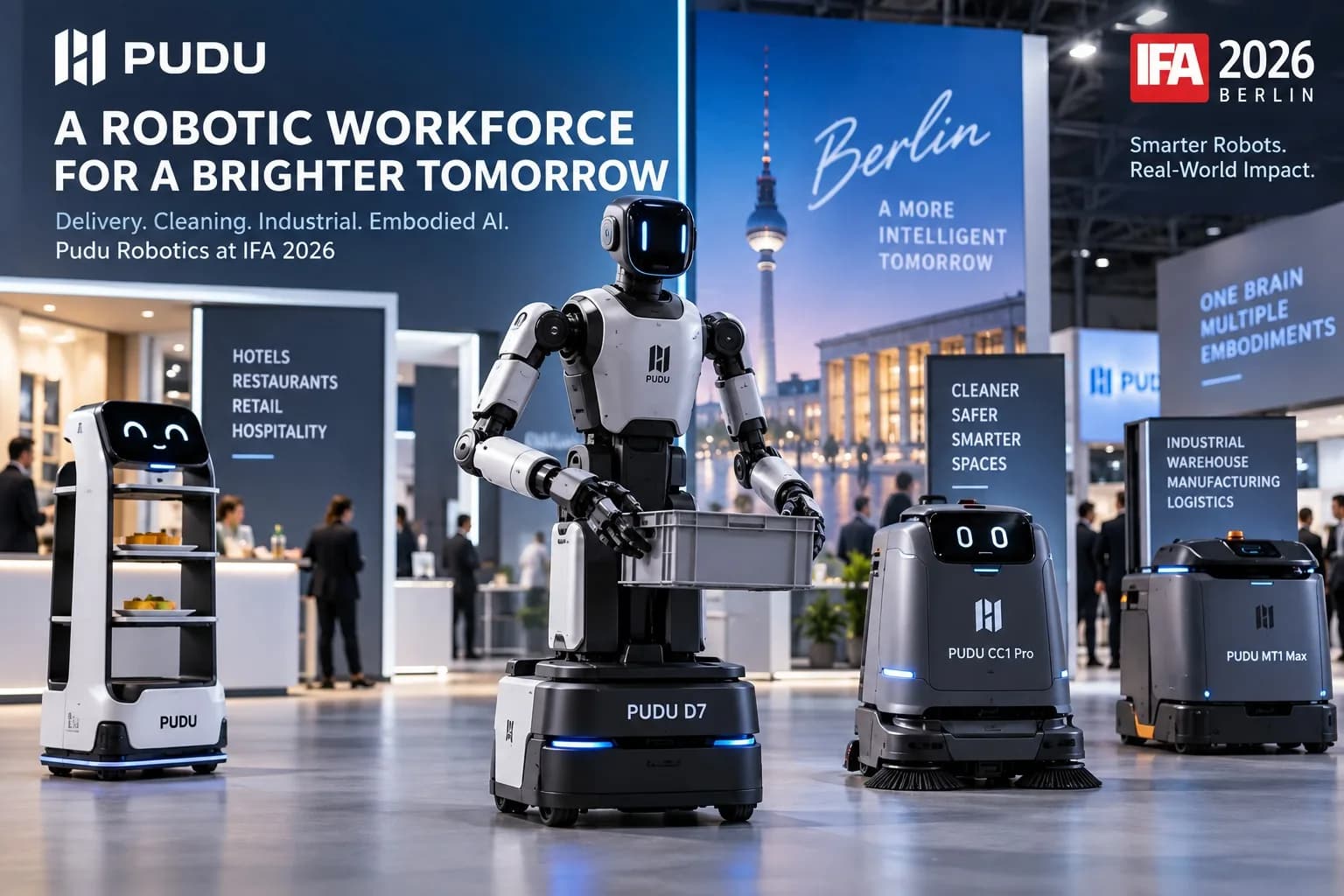
Imagine walking through a hotel where a robot quietly delivers room-service orders. A few metres away, another robot cleans the floor without being told exactly where to go. Inside a warehouse, an intelligent machine moves materials between workstations.
Then you see something different. A robot with two arms is picking up objects, handling materials and performing tasks that previously required far more specialized automation. That robot is the PUDU D7.
At IFA 2026 in Berlin, Pudu Robotics is putting a broad range of commercial robots in front of the European market, bringing together embodied AI, delivery automation and autonomous cleaning under one roof.
And the bigger story isn't simply that Pudu has built another robot. It is that the company is trying to build an entire robotic workforce for the physical world.
Pudu Robotics Arrives at IFA 2026 With a Bigger Vision
IFA Berlin 2026 runs from September 4–8, with Pudu Robotics Europe exhibiting in the IFA Next area at Messe Berlin. Its featured lineup includes the PUDU D7, along with commercial cleaning machines such as the PUDU CC1 Pro and PUDU MT1 Max. Pudu's wider portfolio also stretches across commercial delivery, industrial delivery and embodied-AI robots.
That diversity matters. For years, the popular image of robotics has been dominated by humanoid machines walking across laboratories or performing carefully choreographed demonstrations. Commercial robotics has been developing in a somewhat different direction. Businesses don't necessarily need a robot that looks exactly like a person. They need robots that can perform useful tasks reliably, safely and economically.
Pudu's strategy appears to recognize that difference. Instead of betting everything on a single humanoid platform, the company is developing robots with different physical forms for different jobs. Pudu calls the philosophy behind this approach "One Brain, Multiple Embodiments." Its portfolio spans service delivery, commercial cleaning, industrial delivery and general embodied AI.
And perhaps the most interesting example of that strategy is the D7.
Meet the PUDU D7: A Semi-Humanoid Built for Work
The PUDU D7 isn't designed primarily to look impressive on a stage. Pudu introduced it in June 2026 as a next-generation industrial semi-humanoid robot designed for manufacturing and industrial environments.
Instead of relying on human-like legs, the D7 uses an omnidirectional mobile chassis. Above that mobile base sits a dual-arm manipulation system. It's an interesting engineering compromise. Human-like arms give the robot the ability to interact with environments and objects designed around people, while the wheeled platform provides a practical way of moving around commercial and industrial spaces.
According to Pudu's IFA profile, the D7 is intended for jobs including:
- material handling,
- high-rack picking,
- object transfer and placement,
- assembly,
- and other precision manipulation tasks. Its dual-arm system combines force control with tactile sensing, allowing it to detect contact and adjust how much force it applies while handling objects.
That distinction is important. Traditional factory automation works brilliantly when the environment is predictable. A robotic arm can repeat the same movement thousands of times with remarkable accuracy. But what happens when the environment changes? What happens when objects move, people walk through the workspace or the robot encounters a situation it hasn't seen in exactly the same form before?
That is where embodied AI becomes interesting.
From Programmed Machines to Robots That Understand Tasks
Traditional automation generally follows predefined instructions. Move here. Pick this. Rotate. Place there. Repeat.
Embodied-AI systems are aiming for something more flexible: robots that can combine perception, reasoning and physical action. Pudu says the D7 is built around PuduFM 1.0, the company's embodied-intelligence foundation model. The goal is to enable the robot to understand tasks, learn from experience and improve its behaviour in real environments rather than depending entirely on rigid, predefined workflows.
Think about the difference this way. A conventional automated machine is extremely good at following a recipe. An embodied-AI robot is being developed to understand more of what the recipe is trying to accomplish. That's a much harder robotics problem.
A useful physical AI system needs to combine cameras, sensors, navigation, AI models, control systems and mechanical hardware—and then make all of them work together in real time. The D7 is Pudu's attempt to bring those capabilities closer to everyday industrial deployment.
But Pudu's European strategy doesn't stop with humanoid-style machines. In fact, some of its less futuristic-looking robots could have a much faster impact on businesses.
Cleaning Robots May Be the Quiet Stars of the Show
Robot cleaners don't usually generate the same headlines as humanoids. They probably should.
Commercial cleaning is exactly the kind of environment where autonomous robots can provide immediate value: large areas, repetitive tasks and predictable operational requirements.
Pudu is bringing machines such as the PUDU CC1 Pro and PUDU MT1 Max to its IFA 2026 presentation. The CC1 Pro combines four cleaning functions—sweeping, scrubbing, vacuuming and mopping. AI vision allows it to identify certain wet stains and adjust its cleaning route, while LiDAR and visual sensing help it navigate commercial environments.
The MT1 Max goes after a different challenge. It's designed as an autonomous sweeper for larger and more complicated environments such as warehouses, parking facilities and industrial floors. Pudu says it combines 3D LiDAR and other sensors with AI-based cleaning capabilities that can adjust operation according to debris and floor conditions.
And Europe is already becoming an important testing ground for Pudu's cleaning ambitions. In April 2026, Pudu announced a partnership with Dutch professional cleaning company Gom Schoonhouden for what it described as the first European deployment of its BG1 Series, a family of AI-native large scrubber-dryer robots.
That moves the story beyond trade-show demonstrations. Robots are beginning to enter actual commercial operations.
Delivery Robots Complete the Picture
Pudu built much of its visibility around service and delivery robotics, and those machines remain an important part of its broader ecosystem. Its current commercial portfolio includes robots designed for restaurants, hotels, retail environments and building delivery.
One example is BellaBot Pro, a delivery and interactive service robot Pudu Robotics is making waves in Europe with its innovative lineup of robots designed to enhance various industries. Picture yourself walking through a hotel and spotting a robot silently delivering room-service orders, while another robot autonomously cleans the floor nearby. In a bustling warehouse, you might see a smart robot efficiently moving materials around.
Among these machines stands the impressive PUDU D7, a semi-humanoid robot that's capable of taking on tasks that used to require specialized automation.
At the IFA 2026 event in Berlin, Pudu Robotics is showcasing its wide array of commercial robots, highlighting their commitment to blending embodied AI, delivery automation, and autonomous cleaning in one place. What's truly exciting isn't just the introduction of new robots; it's Pudu's ambitious plan to create an entire robotic workforce tailored for the physical world.
The IFA Berlin 2026 runs from September 4 to 8, where Pudu Robotics Europe will be featured in the IFA Next area at Messe Berlin. Among their diverse offerings, you'll find the D7 alongside specialized cleaning machines like the PUDU CC1 Pro and PUDU MT1 Max. Pudu's portfolio spans various needs, including service delivery, industrial transport, and embodied AI technologies, emphasizing their strategic approach to robotics.
Traditionally, the image of robotics has been dominated by humanoid robots performing choreographed tasks. However, businesses are often more interested in robots that can reliably and economically perform specific tasks, regardless of their appearance. Recognizing this, Pudu adopts a philosophy they call "One Brain, Multiple Embodiments," which means they're developing robots with different physical designs suited for varying jobs.
The PUDU D7 is a prime example of this approach. Rather than being built for showcase, it was introduced as a versatile industrial robot capable of functioning in manufacturing settings. The D7 features an omnidirectional mobile base topped with a dual-arm system. This design cleverly combines human-like arms for interacting with environments and a practical wheeled platform for navigating commercial spaces.
According to Pudu, the D7 is made for tasks like material handling, high-rack picking, object transferring, assembly, and precise manipulation. Its dual-arm system can adjust force sensitivity, enabling it to handle objects delicately and adaptively, a crucial feature for environments that are not always predictable.
Traditional robots excel at repetitive, predefined tasks, but when the environment changes, such as when people move or objects shift, they can struggle. This is where embodied AI shines, as it empowers robots to perceive their surroundings, reason about tasks, and take appropriate actions.
Pudu claims that the D7 is built on their PuduFM 1.0, an embodied intelligence foundation model. This allows the robot to not just follow instructions but also to learn from experiences and adapt its behavior in real-time environments.
Consider the difference between a robot that merely follows a recipe and one that understands the purpose behind each step. The latter represents a significant leap in robotics. Developing such a system requires the integration of cameras, sensors, navigation tools, and sophisticated AI—all working seamlessly in real-time. The D7 is Pudu's effort to bring these advanced capabilities into everyday industrial use.
But Pudu's vision extends beyond humanoid-style robots. In fact, their more practical robots, like those designed for cleaning, could deliver faster benefits to businesses. While they might not grab as many headlines, commercial cleaning robots play a vital role in maintaining cleanliness and efficiency in various environments. As Pudu Robotics continues to expand its reach, it may just be these quieter, hardworking robots that truly shine in the spotlight.capable of transporting items while also supporting functions such as greeting and guiding customers.
Then there is FlashBot Max, designed specifically around building delivery. The basic idea sounds simple: move something from Point A to Point B. In practice, autonomous building delivery is complicated. A robot may need to navigate corridors, interact with building infrastructure, avoid people and obstacles, and potentially work with elevators before reaching its destination. Pudu's FlashBot family is designed around precisely these kinds of scenarios.
Pudu reported in May that deployments of FlashBot robots with China's Atour Group had surpassed 1,000 units in less than six months, while monthly global sales of the FlashBot series were above 500 units.
That provides an important clue about where commercial robotics may be heading. The future isn't necessarily one universal robot doing everything. It could be teams of specialized robots working together.
"One Brain, Multiple Embodiments" Could Be Pudu's Biggest Bet
Here's where Pudu's strategy becomes particularly interesting.
Imagine a large hotel several years from now. A delivery robot moves meals and supplies between rooms. A cleaning robot detects dirty areas and automatically cleans them. A more capable embodied-AI robot handles objects, restocks supplies or assists with jobs requiring manipulation. All of these machines could eventually operate as parts of the same intelligent ecosystem.
Pudu has already demonstrated early pieces of this idea. At its 2026 Partner Summit, for example, the company described an expanded capability for BellaBot Pro in which AI-based dirt detection could trigger cleaning robots to perform follow-up cleaning.
That may sound like a small feature. Conceptually, it's huge. The robots aren't simply performing isolated tasks anymore. They're beginning to coordinate work. And that changes the conversation from individual robots to robotic infrastructure.
Why Europe Matters for Commercial Robotics
Europe presents both an attractive opportunity and a demanding environment for robotics companies. Businesses across hospitality, logistics, retail, manufacturing, healthcare and facility management are exploring automation, but commercial robots also have to prove that they can work reliably around people.
A flashy demonstration is relatively easy. Operating day after day inside a busy hotel, warehouse, supermarket or factory is much harder. Robots need to navigate changing spaces, avoid obstacles, handle unexpected situations and integrate into existing workflows without becoming another problem employees need to manage.
That makes Pudu's European expansion particularly interesting. Its presence at IFA isn't only about displaying futuristic technology. It's about demonstrating that commercial robotics is expanding into multiple industries at the same time.
Pudu's IFA exhibitor profile says the company has shipped more than 130,000 robots across over 85 countries and regions. The next challenge is turning that scale into deeper real-world integration.
Humanoid Robots vs Specialized Robots: Maybe We're Asking the Wrong Question
Whenever humanoid robots appear, one question usually follows: Will humanoid robots replace specialized robots?
Probably not. At least, not anytime soon.
A floor-cleaning robot doesn't need legs. A restaurant delivery robot doesn't necessarily need arms. A warehouse robot moving materials doesn't always need a human-shaped body. But some environments do benefit from human-like manipulation because our world was designed around human hands, reach and movement.
That's why the D7 is particularly interesting. It sits somewhere between traditional mobile robots and fully humanoid machines. Its design effectively asks: How much of the human form does a robot actually need to perform useful human tasks? For many industrial applications, wheels plus intelligent arms could be a very practical answer.
The Real Robotics Race Is Moving From Demonstration to Deployment
For the last several years, robotics news has often been dominated by spectacular demonstrations. Robots running. Robots jumping. Robots dancing. Those achievements are technically impressive, but businesses eventually ask a less exciting question: What useful job can this robot perform every day?
That is increasingly becoming the defining question of the commercial-robotics industry. Pudu's portfolio reflects that shift. Cleaning robots have obvious tasks. Delivery robots have obvious tasks. Industrial robots have obvious tasks. Embodied-AI machines such as the D7 are attempting to expand the range of tasks that robots can handle without requiring a completely redesigned environment.
The winners of the next stage of robotics may therefore not be determined by who creates the most human-looking machine. They may be determined by who creates robots that businesses can actually deploy, maintain and justify economically.
What Comes Next?
The PUDU D7 may attract much of the attention at IFA 2026 because semi-humanoid robots represent one of the industry's most exciting frontiers. But the bigger story is sitting around it.
Delivery robots. Cleaning robots. Industrial robots. Embodied-AI systems. All of them are slowly becoming parts of a much larger automation ecosystem.
Pudu is effectively betting that there won't be one perfect robot for the future. There will be many physical forms connected by increasingly capable intelligence.
If that strategy works, the robot revolution might not arrive with a dramatic moment when humanoids suddenly walk into every workplace. It may happen much more quietly. A cleaning robot appears in a shopping centre. A delivery robot starts working in a hotel. An industrial robot begins transporting materials inside a factory. A semi-humanoid starts handling jobs that previously required human dexterity.
Then one day, we look around and realize something has changed: robots aren't coming anymore. They're already at wor