
Robotic Sir Blog
How AgTech Is Transforming Modern Agriculture: The Rise of Smart Farming Robots
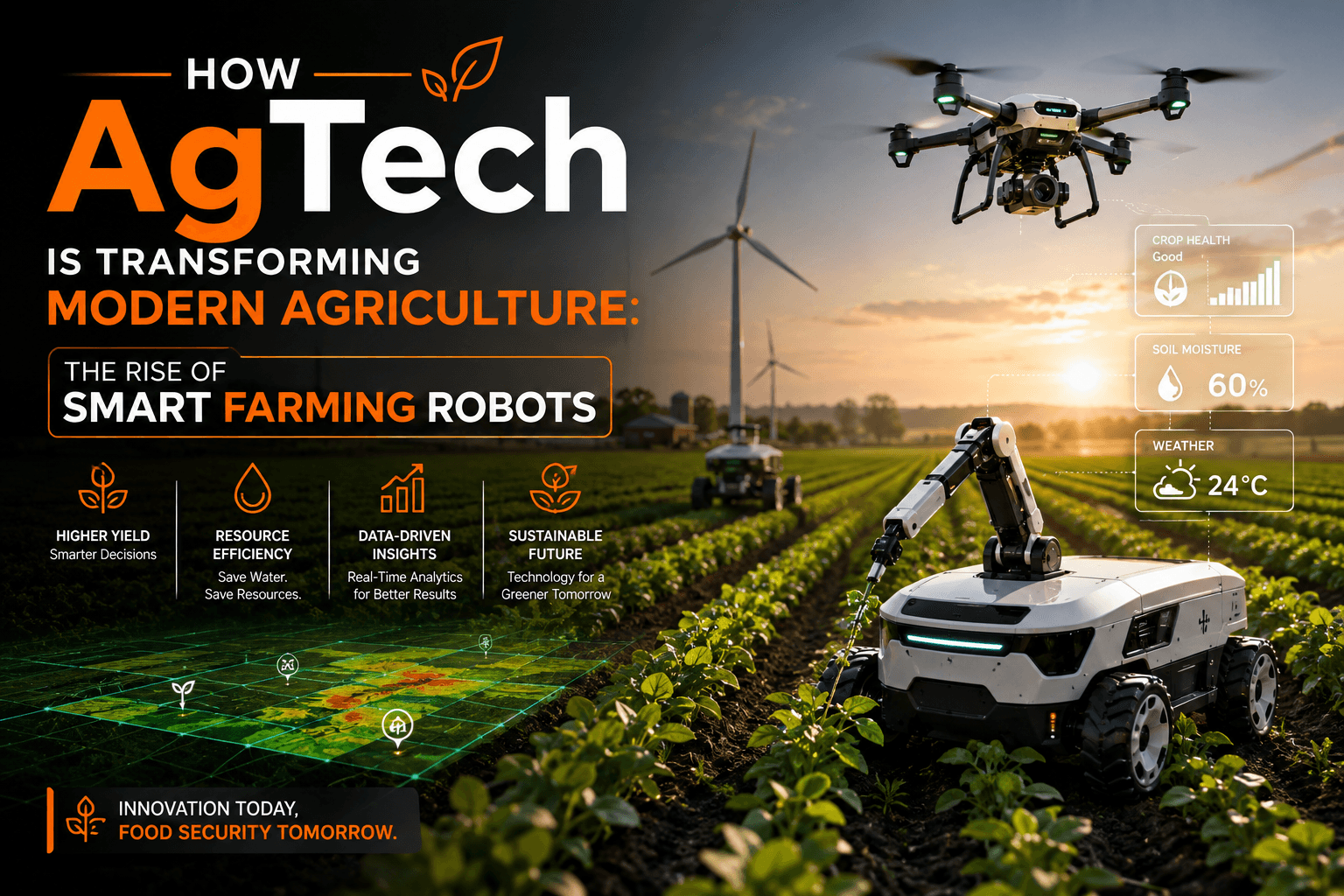
You could notice something strange if you go around a contemporary farm today.
Even though there aren't as many individuals going between the crop rows, there is a lot more intelligence passing between them.
A camera looks at thousands of plants. Soil moisture is silently measured via sensors. Fields are surveyed from above using drones. Without damaging the crop, an automated piece of equipment walks between rows, finds weeds, and pulls them. Somewhere else, software is integrating crop, soil, and weather data to assist a farmer in determining when to harvest, spray, or water.
This is an example of AgTech. Tractors, tools, and human experience are no longer the primary factors driving agriculture as we move into a new era. Artificial intelligence (AI), robotics, Internet of Things (IoT) sensors, computer vision, drones, GPS, and data analytics are increasingly driving it.
The goal isn't to replace farmers — it's to provide farmers with what they've always needed: improved tools, increased accuracy, and better information.
From precision farming to climate-smart agriculture, digital technology and artificial intelligence can help create more resilient, sustainable, and efficient agrifood systems, according to the Food and Agriculture Organization (FAO).
The agricultural robot is one innovation that sticks out amid all of these technologies.
AgTech: What Is It?
Agricultural technology, or "AgTech," refers to a wide range of technologies intended to enhance farming and the food chain. That includes:
- AI and machine learning
- Agricultural robots
- Autonomous tractors
- Drones
- IoT sensors
- GPS and precision agriculture
- Computer vision
- Satellite imagery
- Smart irrigation
- Automated harvesting
- Digital farm-management platforms
Consider AgTech as agriculture's new digital layer.
A farmer can be informed via a soil sensor that a specific area of a field is getting dry. Crop stress can be seen through drone or satellite images. AI can analyze that information. A smart irrigation system can then deliver water where it is actually needed.
Now add a robot to the equation. The robot can physically move through the field and perform the task.
Why Does Agriculture Need Robots?
Farming has always been a challenging mix of labor, timing, and unpredictability.
There might not be much time for a farmer to plant a crop. Weeds fight for water and nutrients. Before issues become apparent to the human eye, crops may experience stress. Large volumes of seasonal labor are frequently needed for harvesting. At the same time, farms are dealing with changing weather patterns, water constraints, and pressure to use inputs more efficiently.
FAO's research on agricultural automation highlights potential benefits including greater productivity, improved resource efficiency, resilience, and environmental sustainability — while also warning that unequal access to automation can increase inequality.
A different strategy is provided by robotics. Instead of treating an entire field as one giant uniform surface, robots can increasingly work at the level of individual plants, rows, or specific areas.
That shift — from treating the field as a whole to understanding what is happening plant by plant — is one of the most important ideas behind smart farming.
Intelligent Agricultural Robots: Transitioning from Mechanisms to Decision-Makers
Agricultural automation's initial generation was rather straightforward. A machine traveled along a preset path. The agricultural robots of today are getting much more advanced. A typical intelligent farming robot is capable of combining:
- GPS
- AI
- Cameras
- Sensors
- Mechanical tools
- Navigation
The camera observes. The sensors take measurements. The AI does the interpreting. The navigation system determines where to go. The mechanical system carries out the task.
For instance, a robot traversing a field of vegetables could use computer vision to tell a crop from a weed. The device may target specific weeds rather than applying herbicide to a whole region. The core promise of precision robotics is this:
Don't handle everything. Treat what is truly in need of care.
Robotic Weeding: Educating Machines to Recognize Weeds
Although weeding seems easy, it is a difficult visual task for a robot. Weeds and crops can have strikingly similar appearances, and it can be challenging to distinguish between them due to shifting sunlight, soil, wind, and overlapping leaves.
Smart weeding robots can recognize individual weeds and eliminate them with mechanical tools or precise technologies like lasers, thanks to AI and computer vision.
The robot alone isn't the true breakthrough — it is the capacity to make judgments at the plant level, possibly cutting down on needless chemical consumption and increasing accuracy.
Autonomous Tractors: Upon the Driver's Departure from the Cab
The conventional tractor is getting smarter. With little assistance from humans, autonomous tractors explore fields using GPS, cameras, sensors, and artificial intelligence. Farmers can oversee automated activities and concentrate on managing the larger farm rather than spending hours operating machinery.
Farmers won't necessarily be replaced by robots in the future. Farmers are in charge of fleets of sophisticated devices.
The Farmer's Eye in the Sky: Drones
In addition to offering a bird's-eye perspective of crops, agricultural drones can help with field mapping, irrigation planning, disease identification, plant health evaluation, and crop monitoring.
Consider it this way:
Drones have a broad perspective. Robots on the ground look into the specifics.
When combined, these technologies can make farms more interconnected and constantly monitored.
The Data Is the True Power, Not the Robot
The robot is just one aspect of the narrative.
Robots, drones, satellites, soil sensors, and weather stations can all provide data to modern farms. AI may then evaluate this data to assist farmers in determining where crops might require protection, fertilizers, or water.
This transforms farming from merely gathering data to acting upon it.
Will Robots Replace Farmers?
Probably not.
Farmers bring experience, judgment, and knowledge of local conditions. Robots bring precision, consistency, and automation.
The more realistic future is human-machine collaboration:
Farmer decides → AI analyzes → Robot acts → Data returns → Farmer decides again.
Rather than replacing farmers, robotics could change what farmers spend their time doing.
As AgTech continues to evolve, smart farming robots, AI, and agricultural robotics are shaping the future of farming — helping farmers improve efficiency, reduce waste, and make smarter, more sustainable decisions.