
Robotic Sir Blog
GENE.01: The Humanoid Robot That Could Change Human–Robot Collaboration
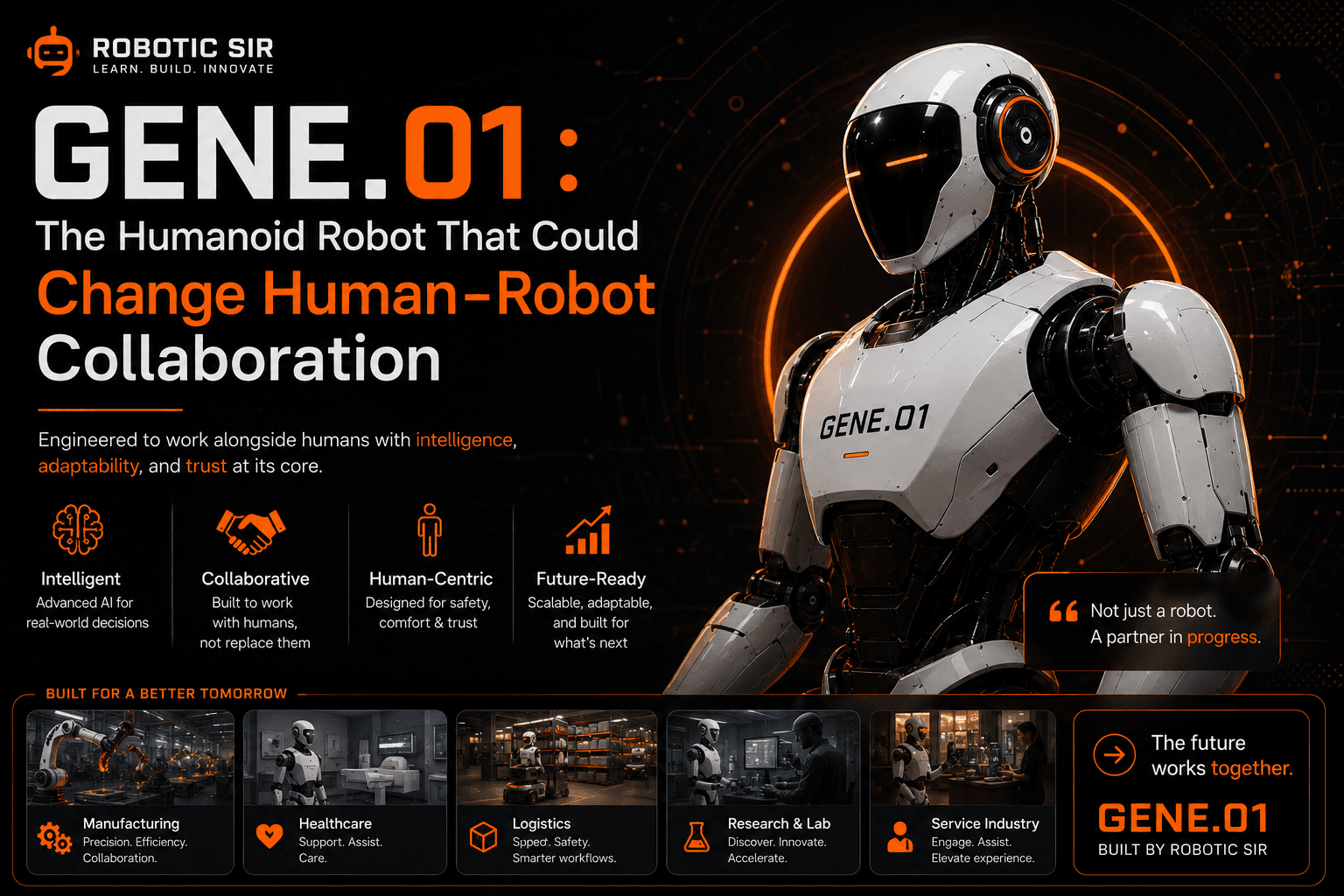
The world of robotics is moving faster than ever, and every few months we see a breakthrough that changes how we think about intelligent machines. One of the latest developments is GENE.01, a new multimodal smart-skin humanoid robot introduced by Generative Bionics. What makes this announcement even more surprising is that the company built the platform in just six months after raising an $81 million seed investment.
As an 18-year-old student who is passionate about robotics and artificial intelligence, I find this launch exciting because it represents more than just another humanoid robot. It reflects how robotics is shifting from building machines that simply perform tasks to creating systems that can safely understand and interact with humans in real-world environments.
What is GENE.01?
GENE.01 is a next-generation humanoid robot platform designed to work alongside people rather than replace them. Unlike traditional industrial robots that operate inside safety cages, GENE.01 has been developed for direct human collaboration.
Its biggest innovation is its multimodal smart skin. Instead of relying only on cameras or external sensors, the robot's body contains distributed sensing technology that allows it to detect touch, pressure, force, temperature, and nearby objects.
This means the robot is constantly aware of what is happening around its body. If a person accidentally comes into contact with the robot, it can immediately recognize the interaction and respond safely.
Why Is Smart Skin Important?
Human skin continuously gathers information from the environment. We instantly know when something is hot, when someone touches us, or how much force we are applying while holding an object.
GENE.01 attempts to bring a similar capability into robotics. Its smart skin allows the robot to:
- Detect physical contact
- Measure the amount of force being applied
- Sense nearby people and objects
- Recognize temperature changes
- Improve safety during human-robot collaboration This technology makes robots more suitable for workplaces where humans and machines share the same space.
The Science Behind the Robot
One of the most interesting aspects of GENE.01 is that it is based on research previously published in Nature Machine Intelligence using the ergoCub humanoid robot.
Instead of designing hardware first and then writing software later, the researchers use what they describe as physics-native AI.
In simple words, the robot's physical structure and its AI control system are designed together. This allows movements to become more efficient, balanced, and safer for people working nearby.
This approach could significantly improve future humanoid robots because intelligence is built into both the hardware and the software from the beginning.
Open Source Could Accelerate Innovation
Another major announcement from Generative Bionics is that the digital twin of GENE.01 will be open-sourced.
A digital twin is a virtual version of the robot that developers and researchers can use to simulate, test, and improve algorithms without needing physical hardware.
The company plans to release support across:
- PyPI
- Conda
- ROS ecosystem repositories For students, researchers, and robotics developers, this is a valuable step because it lowers the barrier to experimentation and encourages collaborative innovation.
Open-source robotics has already accelerated fields like computer vision and autonomous navigation. GENE.01 could contribute to a similar wave of progress in humanoid robotics.
Building a European Robotics Ecosystem
The company is also focusing on developing a sovereign European robotics supply chain.
It has partnered with Germany's Synapticon to build a European actuation stack instead of relying entirely on external suppliers.
In manufacturing, former Ferrari production manager Federico Santini has joined as Chief Production & Industrialization Officer. His experience in large-scale industrial production could help move GENE.01 from a research platform into commercial manufacturing.
Generative Bionics is also working alongside industrial partners including Fincantieri and Italdesign, showing that the project is already receiving support from established engineering organizations.
Why This Matters for the Future of Robotics
Many people believe the future of humanoid robots depends only on making them more intelligent.
I think intelligence alone is not enough.
A robot also needs to understand physical interaction, react safely around humans, and adapt naturally to changing environments.
GENE.01 moves in that direction by combining AI reasoning, tactile sensing, ergonomic design, and open-source development into one platform.
Instead of focusing only on automation, it focuses on collaboration.
That shift could become one of the defining characteristics of the next generation of humanoid robots.
My Perspective
As a student learning robotics and AI, I see GENE.01 as an example of where the industry is heading.
Future engineers may no longer build robots by separating mechanical engineering, electronics, and artificial intelligence. Instead, these disciplines will increasingly be designed together from the very beginning.
I also appreciate the company's decision to open-source the robot's digital twin. For students who cannot access expensive humanoid robots, simulation environments provide an opportunity to learn, experiment, and contribute to research.
Developments like these remind us that robotics is no longer just about building machines that complete repetitive tasks. It is becoming about creating intelligent systems that can safely work with people in factories, hospitals, laboratories, homes, and many other environments.
Frequently Asked Questions
What is GENE.01? GENE.01 is a multimodal smart-skin humanoid robot platform developed by Generative Bionics for safe human-robot collaboration.
What makes GENE.01 different from traditional robots? It combines tactile sensing, force detection, temperature sensing, proximity awareness, and AI-based motion control to interact safely with people.
What is a digital twin? A digital twin is a virtual replica of a physical robot that allows developers to simulate, test, and improve robotic systems without needing the actual hardware.
Why is open-source robotics important? Open-source platforms allow students, researchers, and developers to build new applications faster, share improvements, and accelerate innovation across the robotics community.
Final Thoughts
GENE.01 is still at an early stage, but its launch highlights several important trends that are shaping the future of robotics: multimodal sensing, physics-native AI, open-source development, and safe human-robot collaboration.
Whether GENE.01 becomes a commercial success or simply inspires future research, it already demonstrates how quickly humanoid robotics is evolving.
For students like me, it is also a reminder that the future of robotics will not belong only to those who can build intelligent machines. It will belong to those who can design robots that understand people, interact safely, and solve real-world problems.