
Robotic Sir Blog
FROM ISRO TO AUTOMATION :HOW INDIA IS SHAPING GLOBAL ROBOTICS
In February 2026, India made a giant leap in industrial humanoid robotics with the launch of Elixis-W, a wheeled humanoid robot made in India by Addverb Technologies. The robot, meant for industrial applications such as warehouses and factories, was displayed at LogiMAT India 2026 in Mumbai.
Unlike traditional industrial robots which usually perform a fixed task in a controlled area, Elixis-W intends to combine mobility, perception, learning, and manipulation — human-safe, dexterous, and built for dull, dirty, and dangerous tasks. This enables it to move about industrial settings, manipulate objects, and carry out tasks that might be repetitive, physically taxing, or potentially dangerous to human workers.
Humanoid on Wheels: Presenting Elixis-W
Rather than an ordinary two-legged robot, Elixis-W is designed to move on wheels. The most unique thing about it is this wheeled design — while two-legged robots are more widely recognized globally, Elixis-W is India's first industrial humanoid robot on wheels.
Addverb says this is a practical approach, because the floors in warehouses and factories are usually quite flat and structured. This means that in existing industrial environments, it is easier to add wheeled mobility than walking robots with their added complexity.
Specifications:
- Payload: 10 kg
- Maximum speed: 1.5 m/sec
- Battery life: ~2 hours (targeted)
- Sensing: stereo depth cameras, 3D lidar, IMUs, and joint sensing across the wider Elixis platform
India is emerging as a serious contributor to global robotics, and Elixis-W is an important example of that transition.
As Addverb explains, this wheeled approach offers greater stability and faster integration with infrastructure than walking robots, since factory and warehouse floors are typically flat and structured.
Why Wheeled Humanoids Could Change Industrial Automation
One of the most interesting things about a wheeled humanoid robot is that it can move around a factory or warehouse while also handling objects. In simple terms, it brings together the mobility of a warehouse robot and the working ability of a robotic arm.
Unlike a robotic arm that usually stays in one place, a mobile robot like Elixis-W can move from one area to another and assist with different tasks. It could be used for jobs such as:
- Moving materials
- Picking and sorting items
- Carrying out inspections
- Handling repetitive work that takes up a lot of workers' time
According to Addverb, Elixis-W is being developed for areas such as intralogistics, manufacturing, and supply-chain operations. The idea is not necessarily to replace people, but to take on repetitive, physically demanding, or potentially risky tasks and make industrial workplaces more efficient and safer.
This is where wheeled humanoids could become particularly useful. Instead of building a separate robot for every task, companies could eventually use one adaptable machine for several different jobs across a facility.
Made in India, Built for the World: A Revolution
The importance of Elixis-W goes beyond the robot itself. Its development reflects India's growing ambition to become a contributor to the global robotics and Physical AI ecosystem.
India has traditionally been recognized for its software and engineering talent, while advanced robotics hardware has been dominated by countries such as China, Japan, South Korea, Germany, and the United States. Products such as Elixis-W demonstrate how Indian companies are attempting to move further into sophisticated hardware, AI, and automation.
Addverb has also developed robotics and automation solutions for markets beyond India, giving its humanoid initiative a potential international dimension.
The Challenges of Robotics
Robots may be getting smarter, but they are not perfect. Some of the biggest hurdles include:
- Cost — building and installing advanced robots can be expensive, and smaller companies may not have the budget to adopt them easily.
- Maintenance — robots need regular upkeep, updates, and skilled people who know how to operate and fix them.
- Jobs — as companies automate more repetitive tasks, some workers may worry about losing their jobs or having to learn completely new skills.
- Unpredictability — robots can still struggle with unexpected situations that humans handle naturally.
- Reliability — for humanoid robots in particular, issues like battery life, safety, and working safely around people still need improvement.
Robotics has huge potential, but there is still a long way to go before robots can handle everything humans do.
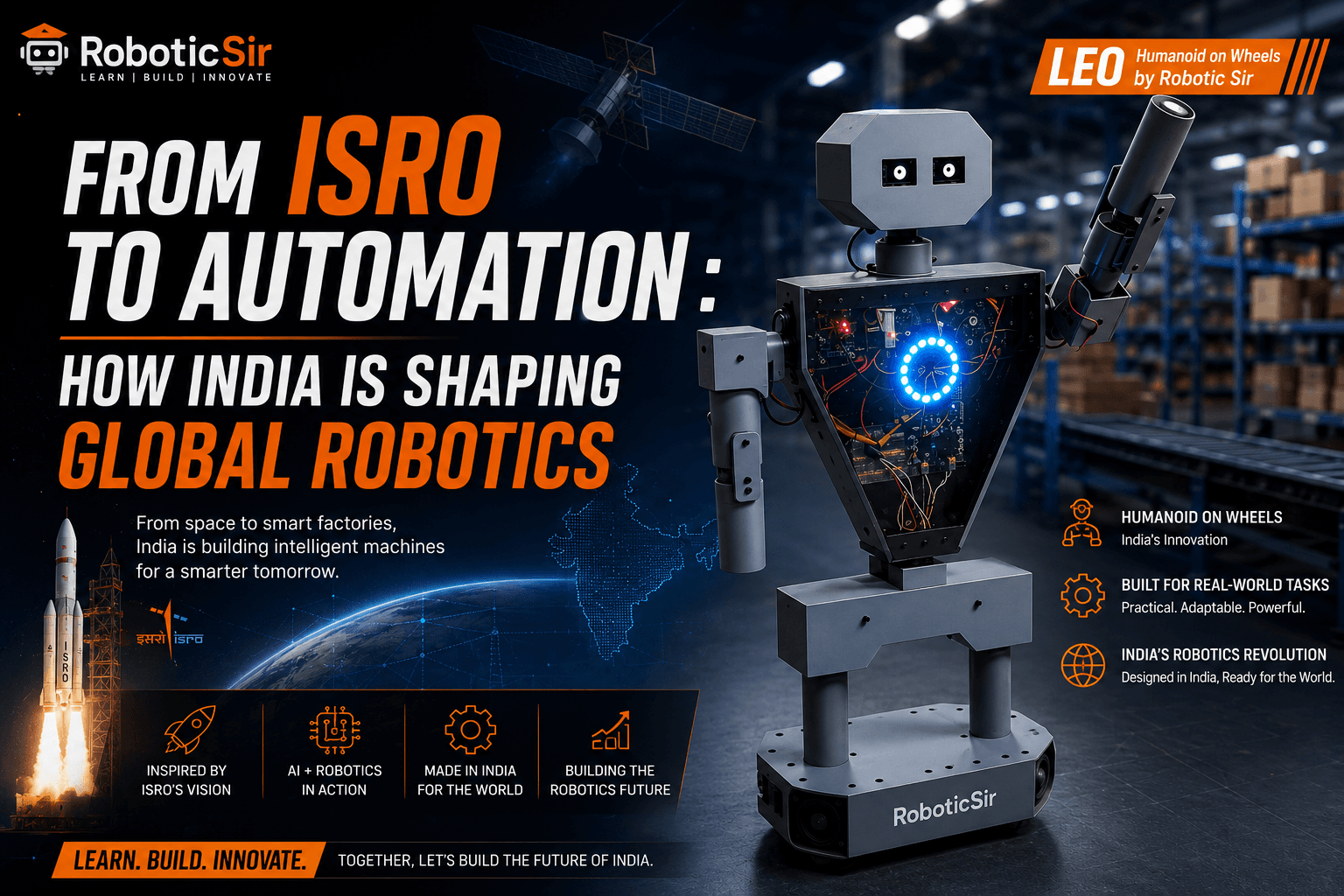
LEO: Humanoid on Wheels by ROBOTICSIR AI India Pvt Ltd
LEO is a humanoid robot developed by ROBOTICSIR AI India, demonstrating the developing potential of robotics and artificial intelligence in India. LEO is designed to demonstrate human-like robotic interaction and intelligent automation, exemplifying the integration of robotics, sensors, programming, and AI into a single platform.
Its development shows how developers in Indian robotics are trying to build devices that can sense their surroundings, communicate with people, and do meaningful jobs. As humanoid robotics continues to progress, projects like LEO show the potential for robots to become important assistants in education, research, industry, and other real-world contexts.
LEO's features include:
- Voice recognition
- Domestic assistance
- Human interaction
- Voice-controlled interaction
- Wi-Fi and smart device integration
- An always-connected AI assistant
VIREX (Jonny): The Future of Humanoid Robotics on Wheels
The futuristic techbot Jonny can welcome people, recognize gestures, and respond in a way similar to a person. It's entertaining in addition to being useful for work — it can perform kung fu and dance. Like people, it socializes too, giving you a high five to greet you.
It's operated using natural vocal commands. To help users learn more about core electronics, it has memory and repeats learned operations, such as MOSFET lock and unlock.
Join ROBOTICSIR and go beyond just using kits for projects — Jonny can address your conceptual inquiries and even carry and transport small products, making it your mini delivery buddy. It moves with agility and stability.
Elixis-W, VIREX, and LEO represent more than new robots for India — they signal India's growing ambition to design, build, and export the next generation of intelligent machines.