
Robotic Sir Blog
From Freedom to Future: How AI and Robotics Can Shape a New India
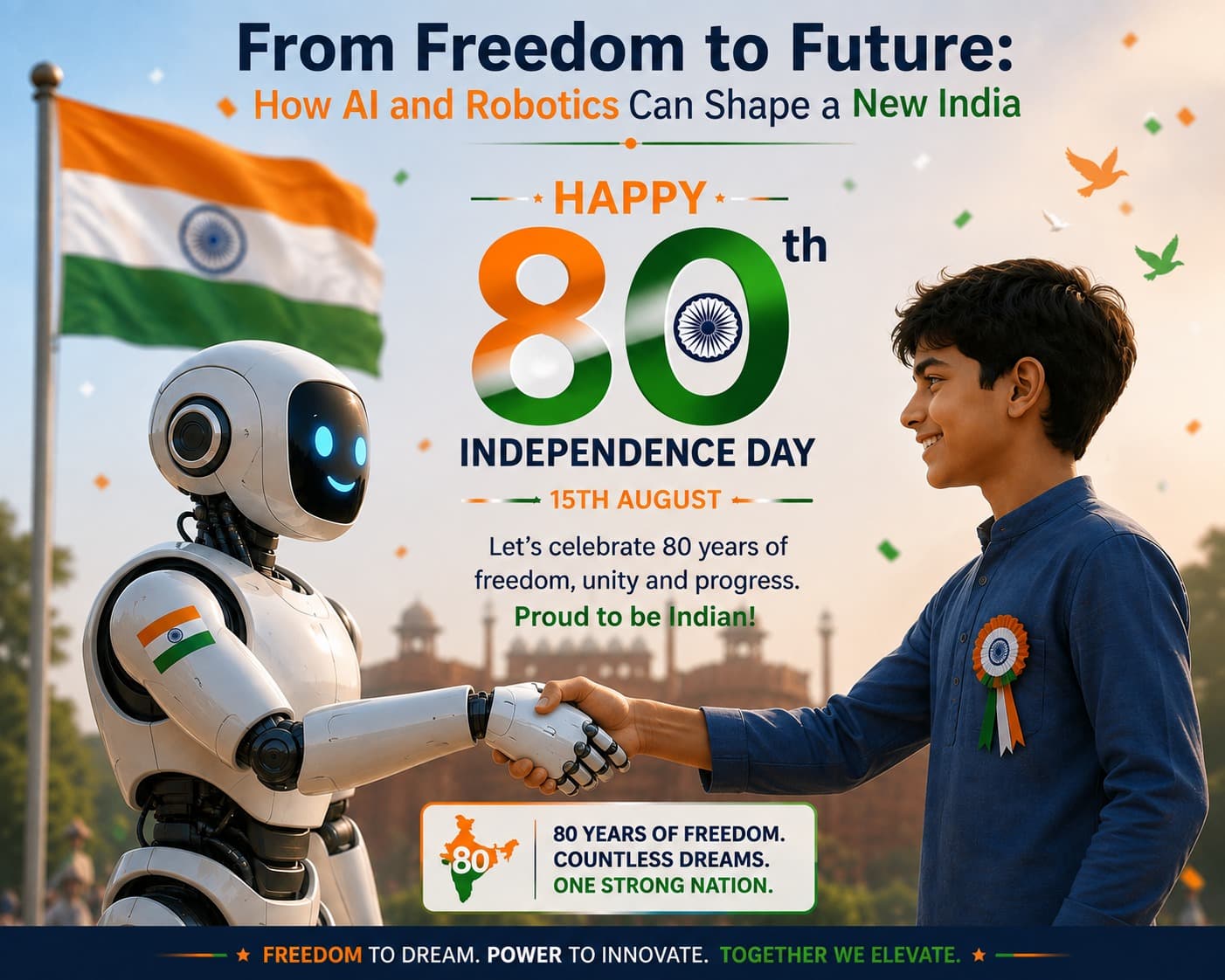
India, Happy Independence Day! Every Indian commemorates the bravery, selflessness, and vision that led to our country's independence on August 15. However, independence is about creating the future as much as commemorating the past. And today, robotics, automation, artificial intelligence (AI), and emerging technologies are all playing a bigger role in shaping that future.
India is embarking on a new technical era as it commemorates its 80th Independence Day. Artificial intelligence, robotics, quantum technology, and data centers were emphasized as significant new frontiers for India in today's Independence Day speech. Additionally, a significant announcement was made to train one crore young people in AI over the course of the following year.
A Reinterpretation of "Atmanirbhar Bharat" in the AI Age
For many years, India's path to independence has been centered on digital technology, manufacturing, agriculture, space, and defense. Self-reliance is already expanding to include robotics and artificial intelligence.
In addition to software developers, the future India will require robotics engineers, AI researchers, chip designers, automation specialists, data scientists, and entrepreneurs who can create technology to solve global problems.
Using AI and robotics created abroad should not be the exclusive objective. India is able to construct them.
From Artificial Intelligence to Physical AI
Historically, AI has existed within computers and smartphones. However, robotics is transitioning AI into the tangible world. A robot is capable of perceiving its environment through cameras and sensors, processing information using AI, making determinations, and executing physical tasks. This integration is increasingly referred to as physical AI.
India has the potential to implement this technology in sectors such as agriculture (like the AgTech we covered in our last blog), healthcare, manufacturing, logistics, education, and disaster management.
To be a part of this robotics universe, join ROBOTICSIR — to be the creator, not the consumer.
For instance, robotics might aid farmers in monitoring their crops, support doctors during intricate procedures, automate hazardous industrial activities, and enhance operations in warehouses and manufacturing.
Recent advancements indicate that this is not merely a concept for the distant future. Indian robotics firms are actively investigating applications like AI-driven agriculture, while healthcare robotics is proving to be another significant area of growth.
However, technology must create opportunities, not just automation. There is also one key question that we cannot ignore: will AI and robotics replace humans in jobs?
The answer is difficult. AI and automation will undoubtedly transform many jobs. Generative AI is transforming traditional technology and outsourcing labor, causing disruption in India's IT business. However, technology has the potential to provide entirely new job opportunities. The true difficulty is to ensure that employees and students have the opportunity to reskill and adapt.
A robot should not be viewed solely as a machine that replaces human labor. It can also serve as a tool for people to accomplish risky, repetitive, or physically demanding work in a safer and more efficient manner. In the future, people should collaborate with intelligent machines rather than simply compete against them.
The Automation Paradigm Shift in India
The robotics industry in India is growing at an unprecedented rate, surpassing several traditional industrial economies with double-digit market growth. The country is shifting from being a consumer of automation to a hub for localized development thanks to:
- "China+1" supply chain diversification
- Multibillion-dollar Production Linked Incentive (PLI) frameworks
- Aggressive greenfield manufacturing expansions by global electronics and automotive giants (like Foxconn and Tata Electronics) By combining sophisticated Autonomous Mobile Robots (AMRs) with Physical AI and Vision-Language-Action (VLA) models, domestic innovators like Addverb Technologies are driving this transformation.
For robotics developers and engineering students, this means that the ecosystem is moving away from straightforward line-following prototypes and toward intricate, edge-AI-driven orchestration — creating a pressing need for people with expertise in ROS/ROS2, SLAM navigation, and real-time sensor fusion.
Let's Dream Beyond the Flag on Independence Day
Freedom is symbolized by the tricolor. However, freedom also entails having the self-assurance to envision something that does not yet exist. That may be the true link between robotics, AI, and Independence Day.
The India that our independence fighters envisioned was not yet a reality. It's our turn now.
Imagine an India where technology is created rather than just imported. Where AI is produced rather than merely consumed. Where robots are created in Indian labs rather than merely being shown in movies. Where young people fail to inquire, "Will I lose my job to AI?" — but instead inquire, "With AI, what can I build?"
India's next twenty-five years may be shaped by that question.
Happy Independence Day! Let's honor the freedom that gave us the present on August 15, 2026, and strive toward the innovation that will shape the future. From ISRO to AI labs. From software to robots. From Physical AI to Digital India. Build for the World, from Made in India.
The trip is still ongoing. And maybe a young engineer is turning on a robot for the first time in an Indian lab right now. The robot moves forward for the first time. India also takes another.
Happy 80th Independence Day! Jai Hind. Jai Innovation.