
Robotic Sir Blog
Who is winning the race to develop humanoid robots between China and the United States in 2026?
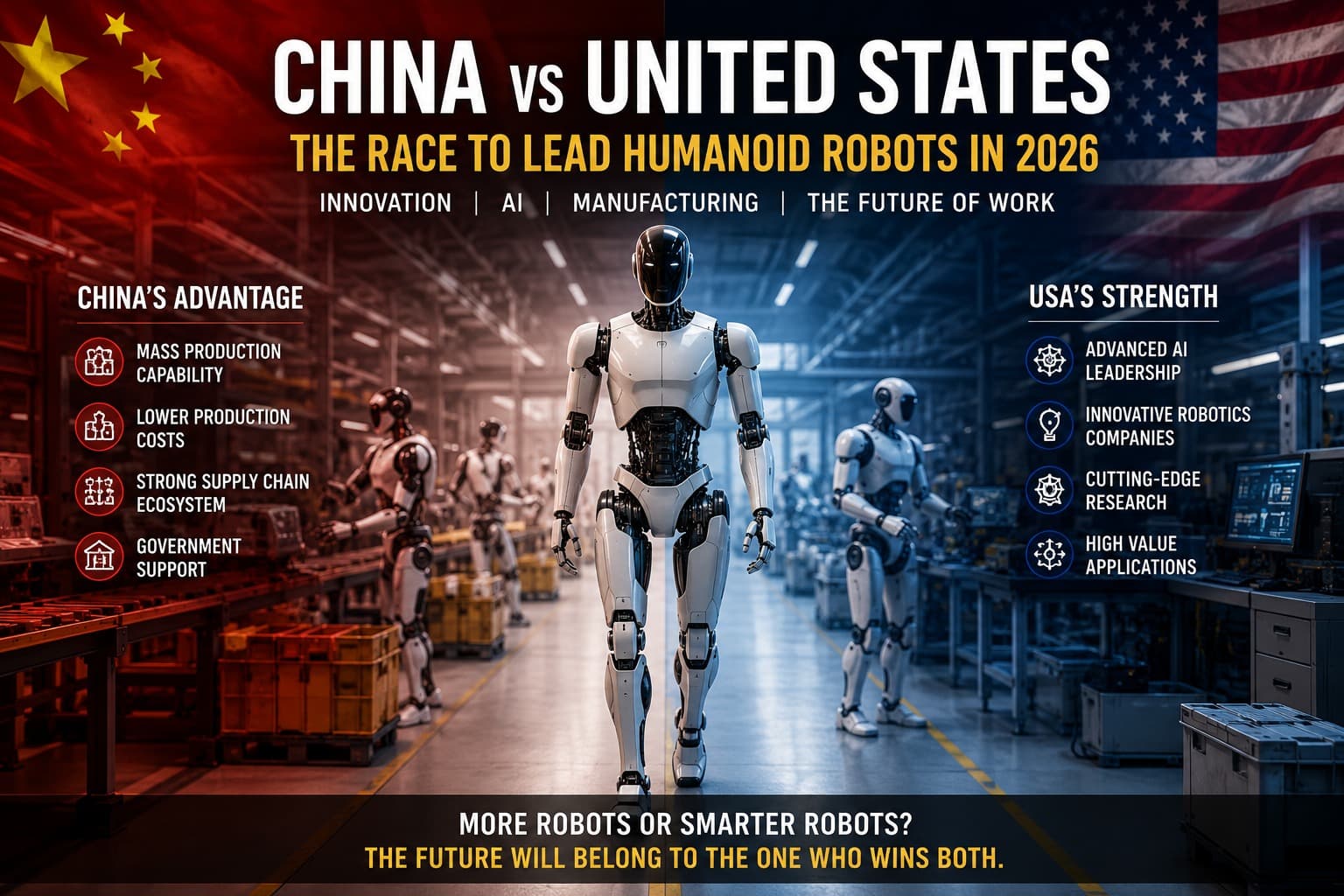
A humanoid robot enters a factory.
A few years back, that sentence sounded as if it had come at the start of a science-fiction story.
By 2026 it might just be the start of a typical working day.
Humanoid robots are moving from research laboratories into factories, warehouses, and real-world testing situations. They are now walking more quickly, picking up objects, learning new tasks, and becoming more capable of working in areas which were originally intended for humans.
China and the United States are the two countries competing for dominance in this new industry. However, they are tackling the challenge in completely different ways.
China is developing robots at an extraordinary rate, and its manufacturers are taking advantage of a vast electronics and automotive supply chain, relatively low production costs, and strong support from the government.
At the same time, the United States is home to some of the most advanced artificial intelligence companies and robotics startups in the world. Tesla is working on Optimus. Figure AI is using humanoids in the automotive manufacturing industry. Boston Dynamics has transformed Atlas from a research project into an industrial product.
So which country is really in the lead?
The answer varies depending on the meaning we attach to "winning."
China now has the better position if the race is about the number of humanoid robots that can be manufactured and deployed. When it comes to developing the AI intelligence which might one day enable robots to be genuinely general-purpose, the United States has significant advantages.
What if the true aim is to develop a robot that is able to walk into almost any workplace, understand what has to be done, and carry out useful work reliably?
Yet neither side has won.
It is precisely this feature that makes the humanoid robot race in 2026 so interesting.
Why 2026 Has Become a Turning Point for Humanoid Robots
Robotics has been around for decades.
Factories currently make use of huge robotic arms for welding cars, warehouses employ autonomous machines to move goods, hospitals make use of robots specially designed for those purposes, and drones as well as autonomous vehicles have shown what can be achieved when AI is combined with hardware.
Humanoid robots are different. Rather than designing the environment to suit a machine, engineers are trying to create machines that can function in environments which have already been designed with us in mind.
Consider a typical factory. There are stairs, shelves, doors, tools, boxes, workstations, carts, handles, and machines with buttons. The design of almost everything has been based on the size and movements of the human body.
A humanoid robot would have a huge advantage since it could make use of that infrastructure without companies being forced to completely redesign their workplaces.
But building this kind of machine is very hard. A humanoid that is to be useful must have reliable legs, dexterous hands, cameras, sensors, powerful electric motors, batteries, AI processors, and advanced control systems.
What is most important is that it has intelligence. Walking across a perfectly flat laboratory floor is one problem. Going through a crowded warehouse, seeing a box in the way, working out how to get around it, picking up the right object, and then carrying on with the task — all without human supervision — presents a completely different problem.
It is there that the real humanoid race is taking place. By 2026, companies will have finally collected sufficient hardware, computing power, and real-world training data to tackle it seriously.
China's Strategy: Build More Robots, Faster
China's biggest advantage is straightforward: it is capable of producing complex hardware on a massive scale.
The same industrial ecosystem which has helped China take control of fields such as consumer electronics, batteries, electric vehicles, and drones is currently being applied to robotics. The humanoid robot involves a number of technologies which are already present within China's manufacturing ecosystem, including:
- Electric motors
- Batteries
- Precision gears
- Cameras
- Sensors
- Actuators
- Controllers
- Electronic components
- Structural materials
- AI computing hardware Because the suppliers are situated relatively near to the makers of robots, companies are able to quickly prototype new machines. A nearby supplier might already be available if the actuator has to be redesigned. When a robot requires a different battery configuration, the manufacturers can collaborate with firms that currently produce millions of battery cells.
That creates something extremely valuable in robotics: iteration speed.
It is uncommon for a manufacturer of robots to get it perfectly right the first time. Robots fall. Motors overheat. Hands are unable to grasp objects. Battery life disappoints. Software makes strange decisions. Each time something fails, it results in another engineering problem.
The company that can build, test, break, redesign, and manufacture robots more quickly has a big advantage. It is precisely in this area that China's industrial ecosystem shows its strength.
In 2026, industry reports have increasingly pointed out this gap: at present, Chinese companies have the advantage in terms of manufacturing scale, the depth of their supply chains, and costs, while the United States is still particularly strong in frontier AI, software, and semiconductor innovation.
The Chinese Companies Driving the Humanoid Robot Boom
China does not possess a single leading figure in the field of humanoid robotics — the ecosystem is becoming more and more crowded.
A number of companies, such as Unitree Robotics, AgiBot, UBTECH, Galbot, and Leju Robotics, are competing in the effort to get humanoid robots from prototype stage to actual products.
That competition matters. Progress can jump significantly when many companies deal with the same engineering problems at the same time:
- A company discovers a cheaper actuator.
- Another improves balance.
- One creates more advanced robotic hands.
- A person finds an even more efficient method of manufacturing.
- The suppliers then make adjustments in order to cater to the expanding market. The result can become a feedback loop:
More companies lead to more robots. More robots make components cheaper. Cheaper components mean more deployments. More deployments create more data. More data helps make better robots.
This is similar to what happened with China's electric vehicle industry — and the scale is now starting to show.
In August 2026, Counterpoint Research reported that the number of humanoid robots shipped had increased greatly, with Chinese companies holding the top positions. AgiBot and Unitree together made up about three-quarters of the shipments in the dataset, and all of the five biggest vendors were Chinese.
It doesn't mean that those robots are more intelligent than American ones. What this does mean is that China is introducing a great many more physical robots into the world — and each robot that has been deployed has the potential to function as a data-generation machine.
Unitree Robotics: The Company That Changed the Price Conversation
One company should be highlighted: Unitree Robotics.
Unitree first gained widespread recognition through its quadruped robots before later making a concerted move into humanoid robots. The G1 humanoid played a role in altering people's expectations regarding the cost of humanoid hardware.
In the past, advanced humanoid robots were research machines which cost a great deal of money. Unitree dealt with the problem in a different way — instead of considering humanoids simply as futuristic projects for laboratories, it started advocating for machines that could eventually be made in a way similar to consumer or industrial hardware.
That price pressure matters. Imagine two robotics companies:
- Company A is able to build 100 robots.
- Company B is capable of constructing 10,000. Even though Company A may at first have better AI, Company B could still have a substantial long-term advantage, since thousands of physical robots can collect a great deal of information about real-world movement, manipulation, and failure.
This is one of the reasons why manufacturing volume has become such an important aspect of the discussion on humanoid AI. Intelligence in the field of robotics isn't solely derived from text on the internet — robots need physical experience. They need examples of:
- Opening doors
- Moving boxes
- Grabbing irregular objects
- Recovering from mistakes
- Walking on different surfaces
- Using tools
- Safely interacting with people It is real robots that generate that data. China desires a large number of them.
AgiBot and China's Push Toward Volume
AgiBot is also a major player from China. The company has become one of the industry's strongest competitors, since the 2026 shipment figures put it in the rank of the world's largest producers of humanoid robots.
What makes AgiBot important is not just the fact that a different company has developed a walking robot — it shows how rapidly China's humanoid ecosystem is becoming competitive within the country.
Unitree cannot just take control and then relax. AgiBot is competing. UBTECH is competing. Galbot is competing. Car companies are looking into the use of robotics. Research institutions are working on developing embodied intelligence. Startups are showing up all along the supply chain.
The internal competition might surprisingly bring about a rapid reduction in costs. We have seen this happen before — Chinese electric vehicles became more capable at the same time as their prices fell, since the manufacturers were obliged to compete fiercely. Humanoid robotics might go through a similar cycle.
China Is Treating Humanoid Robots as a Strategic Industry
China's advantage is not merely one of private enterprise. The government's policy has over time regarded humanoid robotics and embodied intelligence as technologies of strategic importance.
The Ministry of Industry and Information Technology in China had earlier set out plans calling for humanoid robots to move toward mass production and for their wider use in real-world situations. This effort has carried on into 2026 — Chinese authorities have started programmes which encourage humanoid robots and embodied-intelligence systems to be put into real industrial situations rather than having them stay in laboratories.
And in August 2026, China proposed an even more significant step: the development of at least 100 key humanoid-robot standards by 2028, covering