
Robotic Sir Blog
Why Robotics for Kids Is the Best Way to Learn STEM in 2026
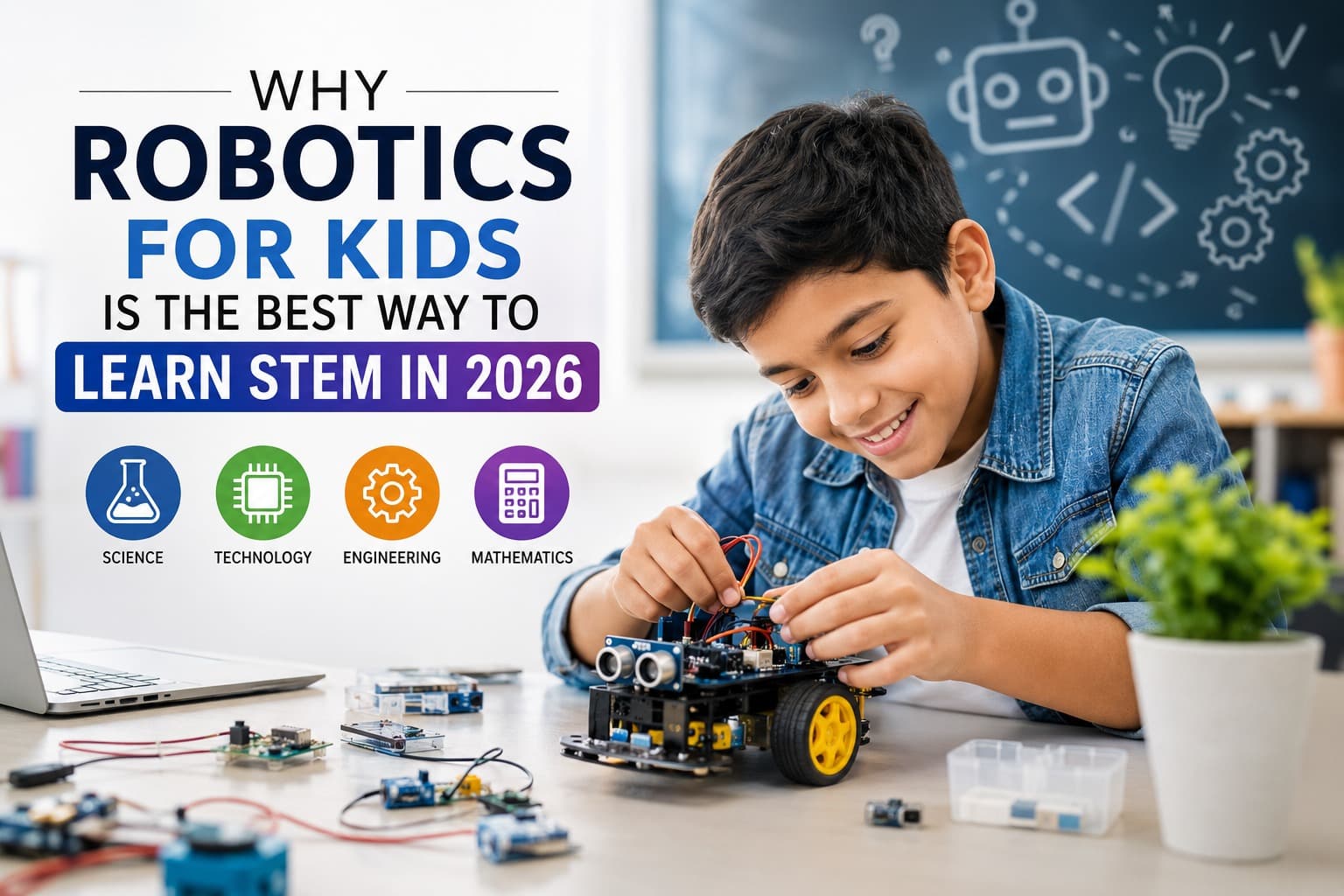
Consider the most recent instance in which a child obtained a new gadget.
They must have looked at it more than that; they probably pressed all the buttons, investigated the things it could do, asked questions, and maybe thought to themselves, "How does this actually work?"
It is this curiosity that marks the true starting point of STEM learning.
In 2026, children are growing up in a world that contains artificial intelligence, smart devices, automation, drones, self-driving technology, and robots. What they experience today is not something they will only come across when they become adults — it is already an integral part of their daily lives.
This creates an important question for parents and educators: what should we do to prepare children for a future that is changing so rapidly?
One of the most exciting answers is robotics for kids.
Robotics achieves what traditional learning usually has a hard time achieving, since it combines science, technology, engineering, and mathematics and turns them into something children can really build, test, and understand.
The best thing is that children are learning while having fun.
What Does Robotics Have to Do with STEM?
STEM is an acronym for Science, Technology, Engineering, and Mathematics.
These subjects are usually taught on their own. A child can study electricity in science lessons, calculations in mathematics, computers in technology classes, and design concepts in another subject.
Robotics brings them all together.
Picture a child constructing a simple robot that is able to avoid obstacles. The child studies electricity and sensors, which is part of science; they handle electronic components and programming, which is related to technology; they put the robot together and improve it, thereby acquiring engineering skills; and they might also make use of measurements, distance, angles, timing, or speed — thus incorporating mathematics into the project.
STEM is no longer made up of four individual school subjects. It turns into an exciting experience.
Robotics Turns Theory Into Real Experience
Children often ask a very reasonable question: where am I going to use this in reality?
They get an answer from robotics.
- Rather than just reading about circuits, children can connect an LED to a circuit and see it glow.
- Rather than just learning the function of a sensor, they can use it to detect light, movement, distance, or touch.
- Rather than reading descriptions of programming commands, they can write code and then see the robot react. This establishes a significant link between learning and doing. It is easier for children to understand and remember what they have learned when they are able to see the practical results of it.
A textbook is able to explain how something works. Children are able to discover robotics on their own.
Mistakes Become Part of Learning
Here is a small secret about robotics: things go wrong all the time.
-
A motor might rotate in the reverse direction.
-
An LED might fail to light.
-
A sensor might give odd readings.
-
A robot that was intended to move forward could decide that spinning in circles is a better option. Surprisingly, that is in fact one of the main advantages of robotics. Rather than being given the right answer right away, children are required to investigate:
-
Has the wire been connected properly?
-
Has the code got a mistake in it?
-
Has the battery been connected correctly?
-
Should the program be altered? This process helps develop problem-solving and critical-thinking skills. Children gradually realize that failure doesn't always mean giving up; it sometimes just means that "something needs to be changed."
That is a lesson of great significance that goes well beyond robotics.
Coding Becomes Much More Interesting
Coding is becoming an important skill, but it can seem confusing to people who are just starting out if they try to learn programming by merely looking at lines of code.
Coding acquires a purpose through robotics. A child enters a command, uploads the program, and as a result something takes place in the real world.
- An LED starts blinking.
- A buzzer makes a noise.
- A motor begins moving.
- A sensor finds an object. The connection becomes simple:
Code → Command → Action → Result
The immediate feedback means that programming is easier to understand. Children can alter the code and see the results, and they start to run experiments: What is the result if I increase this number? Can I get the robot to move more quickly? May I make the LED blink in a different way?
At this point, they are not merely carrying out instructions — they are exploring. It is during exploration that some of the best learning takes place.
Robotics Develops Creativity
On hearing the term "robotics," people usually picture intricate machines and a great deal of technical calculation.
Yet robotics can be rather creative.
If you give a number of children the same materials and ask them to make something useful, the results can be entirely different:
- A single child could produce a smart light.
- Someone else could install a miniature security alarm.
- A person could set up an automatic system for watering plants.
- It is entirely acceptable if another child just constructs something strange and amusing. Robotics enables children to combine their logic with their imagination. Rather than just using technology by means of games, videos, and apps, they start to create technology on their own.
The change from consumer to creator is extremely valuable.
It Helps Children Understand the Technology Around Them
Children interact with technology every day — smartphones, smart speakers, games, apps, AI tools, and a huge number of electronic devices.
But using technology is quite different from understanding technology.
Robotics helps eliminate some of the mystery:
- A child who works with sensors starts to realize how automatic doors could detect people.
- A child who is able to control motors can begin to understand how machines produce movement.
- A child learning basic programming starts to realize that machines obey instructions and logic. Technology no longer appears magical. It reaches a stage where it can be understood, altered, and created.
Robotics Builds Future-Ready Skills
The workplace of the future will keep changing as AI, robotics, automation, and smart technologies become more common.
It doesn't follow that every child has to become a programmer or a robotics engineer. The greater advantage lies in the skills children acquire while building projects. Robotics can encourage:
- Problem-solving
- Logical thinking
- Creativity
- Basic coding
- Engineering thinking
- Teamwork
- Communication
- Experimentation
- Patience
- Confidence in working with technology Such abilities can be put to use in a great many different jobs. A child might one day become an engineer, a doctor, a scientist, a designer, an entrepreneur, a programmer, a researcher, or select a career which nowadays barely exists.
What we are aiming for is not to predict the specific job they will have. The aim is to get them used to learning, adapting, and solving problems.
Learning Feels Less Like Studying
Perhaps the biggest advantage of robotics for kids is simple: it makes learning exciting.
If you tell a child to work out a distance because it's on the worksheet, they might not take any interest. But ask them to calculate the distance because the robot has to stop before it hits a wall, and that calculation suddenly becomes important. The reason for the lesson is clear.
Robotics turns:
- Science into experiments.
- Mathematics into problem-solving.
- Coding into actions.
- Engineering into building. STEM should become something children can experience instead of merely memorizing it.
Is Robotics Difficult for Beginners?
Not necessarily.
It is not necessary for children to begin by constructing complex humanoid robots or learning advanced programming. The best idea is to begin on a small scale.
A person can start by learning about batteries, LEDs, switches, buzzers, motors, and simple sensors; afterward, they can progress to basic circuits, beginner coding, microcontrollers, and finally complete robotics projects.
What we should aim for is not the construction of the most complicated robot. The goal should be to keep children asking: what should I work on next?
Final Thoughts
In 2026, STEM education should go beyond simply memorizing formulas, definitions, and diagrams for the purpose of an exam.
Children should be given the chance to explore, build, ask questions, carry out experiments, fail, make improvements, and create. Robotics combines all of those experiences. Electronics can be introduced through a simple LED project, programming through a sensor project, engineering through a moving robot — and one small experiment can result in hundreds of new questions.
It is for this reason that robotics for kids represents one of the best methods of learning STEM in 2026.
The actual aim is not merely to teach children how to build robots. It is to help them develop the confidence to look at the world around them, find a problem, and think: perhaps I could construct a solution.
That is a skill which should be taken with you into any future.