Robotic Sir Blog
AI versus Robotics: What Is the Difference Between Artificial Intelligence and Robotics?
Imagine a robot standing in front of you. It has cameras for eyes, motors for movement, sensors to understand its surroundings, and a computer inside it. Now imagine that the same robot can recognize an object, understand a voice command, decide what to do, and change its action when the situation changes.
At this point one question naturally comes to mind: is this Artificial Intelligence, Robotics, or both?
The answer is both — AI and robotics are not the same thing.
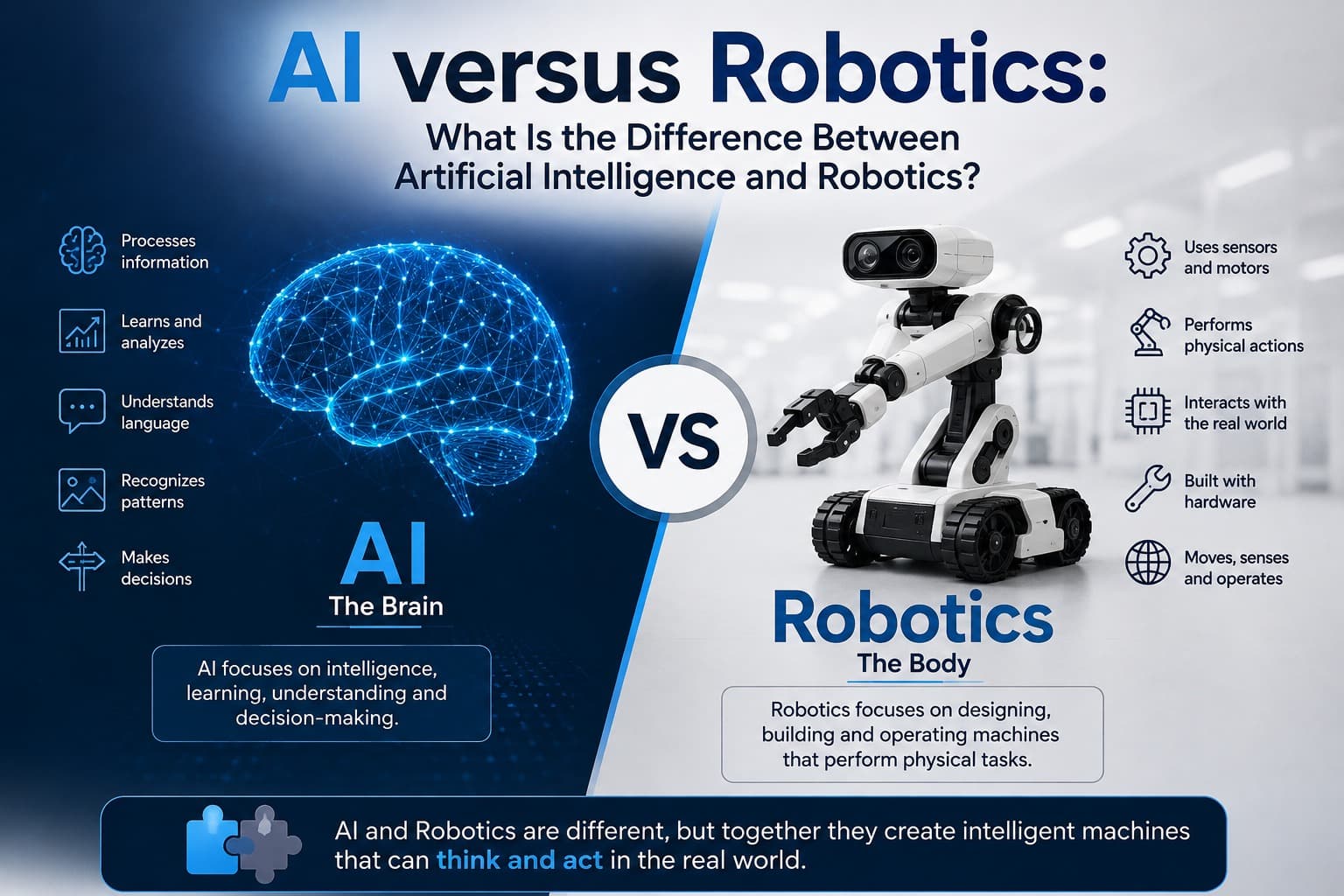
Artificial Intelligence (AI) mainly deals with making computers and machines capable of performing tasks that normally require intelligence. Robotics, on the other hand, focuses on designing and building physical machines that can sense, move, and perform tasks in the real world.
Understanding the difference between AI and robotics is becoming increasingly important as these technologies are being used in manufacturing, healthcare, education, transportation, agriculture, and even our homes. So let's understand the difference in the simplest way possible.
What Is Artificial Intelligence?
Artificial Intelligence, commonly called AI, is a technology that enables computers and software to perform tasks that normally require intelligence.
AI can analyze information, recognize patterns, understand language, identify images, make predictions, and help in decision-making. For example, when a smartphone recognizes your face to unlock the screen, an AI system is involved. When a recommendation system suggests videos or products based on your interests, AI may also be working behind the scenes.
AI does not necessarily need a body. It can exist completely inside a computer, smartphone, server, or other digital system.
Some important areas of AI include:
- Machine learning
- Deep learning
- Computer vision
- Natural language processing
- Speech recognition
- Pattern recognition
- Generative AI
- Decision-making systems In short: AI is mainly about intelligence, learning, understanding, and decision-making.
What Is Robotics?
Robotics is the field of engineering and technology concerned with designing, building, programming, and operating robots.
A robot is a machine that can interact with the real world. Unlike a software-based AI system, a robot normally has components such as:
- Motors
- Sensors
- Cameras
- Wheels or robotic arms
- Microcontrollers or processors
- Power supplies
- Mechanical structures
- Control systems Robotics combines areas of engineering including mechanical engineering, electronics, electrical engineering, and computer science.
For example, a robotic arm in a factory may repeatedly pick up a component and place it in a particular position. That robot does not necessarily need AI — it can simply follow a programmed sequence of instructions.
This is a key point: not every robot uses AI.
AI versus Robotics: The Main Difference
The way to understand the difference is to think about thinking and doing.
AI focuses mainly on processing information and making decisions. Robotics focuses mainly on creating machines that can physically perform actions.
A simple analogy is:
AI = Brain Robotics = Body
This analogy is not technically perfect, but it makes the basic concept easy to understand. AI can tell a system what it should do based on information, while robotics provides the machine capable of carrying out an action.
| Artificial Intelligence | Robotics | |
|---|---|---|
| Focus | Mainly software | Hardware and software |
| Function | Processes information | Can work without a robot |
| Core tools | Algorithms and data | Sensors, motors, and controllers |
| Behavior | Learns, analyzes, and makes decisions | Moves, senses, and interacts with the physical world |
| Example | AI chatbot | Robotic arm |
The important thing to remember is that AI and robotics are separate fields, but they can work extremely well together.
Can AI Work Without Robotics?
Yes. In fact, most AI applications you interact with every day do not have a robot attached to them. For example:
- AI chatbots
- Image recognition
- Language translation
- Recommendation systems
- Voice assistants
- Spam detection
- AI-powered search
- Generative AI tools All of these can use AI without requiring a robot. This is why saying "AI means robots" is incorrect — AI is much broader than robotics.
Can Robotics Work Without AI?
Yes. A robot can operate using fixed instructions without using intelligence.
For example, imagine an arm programmed to move from Point A to Point B repeatedly. It doesn't necessarily need to understand what it is seeing or learn from experience — it simply follows its instructions. This type of automation is extremely useful when the environment and task are predictable.
So: Robot ≠ AI and AI ≠ Robot. They are technologies that can be combined when needed.
Why Do People Connect AI and Robotics?
This is where things become interesting.
A basic robot can follow instructions. But what happens when the environment changes?
Suppose a robot needs to pick up objects from a table, but the objects are not always in the same position. A traditionally programmed robot may struggle if it expects everything to be in a fixed location. AI can help the robot understand what its camera is seeing, identify objects, make decisions, and adapt its actions.
This combination is often called AI-powered robotics or intelligent robotics.
In short:
- Robotics gives the machine the ability to act physically.
- AI gives the machine capabilities for perception, learning, and decision-making. Modern robotics increasingly combines AI with sensors, computer vision, machine learning, and other software techniques to make robots more adaptable.
How Does AI Work Inside a Robot?
Think about a robot as a small system with several stages.
1. Sensors Collect Information
The robot first needs to understand what is happening around it. It may use:
- Cameras
- Ultrasonic sensors
- Infrared sensors
- Touch sensors
- LiDAR
- Temperature sensors
- Encoders These sensors provide information about the robot's environment.
2. AI Processes the Information
The AI system can then analyze the information. For example, computer vision can help identify an object captured by a camera, and machine learning can help the system recognize patterns.
3. The Robot Makes a Decision
Based on the information, the system decides what action should happen next. For example: "There is an object in front of me, so I need to move around it."
4. Motors and Actuators Perform the Action
Finally, the robot physically performs the action. Motors may move wheels, arms, joints, or other mechanisms.
This creates a cycle:
Sense → Understand → Decide → Act
That is where AI and robotics become especially powerful.
Real-World Applications of AI and Robotics
AI and robotics are already being used across industries.
Manufacturing — Factories use robotic arms for assembly, welding, packaging, inspection, and other repetitive tasks. AI can add capabilities such as inspection and adaptive decision-making.
Healthcare — Robotic systems can assist professionals with highly controlled physical tasks, while AI can support analysis and decision-making.
Agriculture — Robotics can be used for tasks such as monitoring crops, navigation, and automated agricultural operations. AI can help analyze images and sensor data.
Warehouses — Robotic systems can move materials and products around warehouses. AI can help with navigation, object recognition, and task planning.
Space Exploration — Robotic vehicles can explore environments that are difficult or dangerous for humans to reach. AI can help these systems interpret sensor information and make decisions, often alongside direct human oversight.
Education — Robotics kits allow students to learn electronics, programming, sensors, automation, and engineering by building projects. This is one reason robotics has become a learning path for students who enjoy both hardware and programming.
AI versus Robotics: Which One Is Better?
There isn't a single answer — it depends on what you want to build.
If you enjoy:
- Programming
- Data
- Algorithms
- Machine learning
- Computer vision
- Software development ...AI may be more interesting to you.
If you enjoy:
- Electronics
- Motors
- Sensors
- Control systems
- Microcontrollers
- Building machines ...robotics may be a better fit.
If you enjoy both? That's where things get really exciting. Learning AI and robotics together can help you build systems that can sense, understand, decide, and act.
AI and Robotics Together: The Future of Intelligent Machines
The biggest change is not really about choosing AI or robotics — the interesting development is the combination of both.
Imagine a robot that can:
- See an object using a camera.
- Identify the object using computer vision.
- Understand an instruction.
- Decide how to approach the object.
- Move its arm.
- Pick up the object.
- Adjust its movement if the object moves. That requires more than a simple motor and a few programmed commands — it requires hardware, sensors, control systems, software, and sophisticated AI. This is why the boundary between AI and robotics is becoming less obvious. Modern intelligent robots are bringing together engineering and AI-based perception and decision-making.
AI vs Robotics: A Simple Example
Let's take a simple example. Imagine a robot vacuum cleaner.
The robotics part includes:
- Wheels
- Motors
- Sensors
- Battery
- Mechanical structure
- Motor control The AI/software side can include capabilities for understanding sensor information, recognizing areas of the environment, planning movement, or making decisions.
Now imagine the AI technology running on a laptop instead — there is no robot, and the AI can still work. This example shows why AI and robotics are connected but not identical.
What Is the Difference Between AI, Robotics, and Automation?
These three terms are often confused.
- AI focuses on processing, learning, recognition, prediction, and decision-making.
- Robotics focuses on machines that can sense and perform actions.
- Automation focuses on making a task operate with minimal human intervention. They can exist independently, and they can also work together. For example:
Automation + Robotics + AI = Intelligent Automated System
This combination is becoming increasingly important in manufacturing, logistics, healthcare, transportation, and other industries.
Frequently Asked Questions
Is AI the same as robotics? No. AI is primarily concerned with software and computational systems, while robotics focuses on physical machines and their operation.
Is a robot an AI? Not necessarily. A robot can operate using fixed instructions without intelligence.
Can AI control a robot? Yes. AI can be integrated with robotic systems to help them understand sensor information, recognize objects, make decisions, and adapt their behavior.
Which is better, AI or robotics? Neither is automatically better — they solve different types of problems. AI is mainly focused on intelligence and information processing, while robotics focuses on machines and actions.
Is robotics a part of AI? Not exactly. Robotics and AI are fields that overlap in many applications. AI can be used as part of a system, but robotics also includes mechanical, electrical, electronics, and control engineering.
Final Thoughts
The difference between AI and robotics becomes much easier to understand when you stop thinking of them as competing technologies.
AI is about making machines more capable of processing. Robotics is about creating machines that can physically interact with the world. When these technologies are combined, something more powerful can happen — a robot can sense its environment, process information, make decisions, and perform actions.
That is why the future of technology isn't simply about AI vs robotics. It is increasingly about AI + robotics.
For students, engineers, and technology enthusiasts, that combination offers an exciting area to explore — because the machines of the future won't just perform instructions. They will increasingly be able to understand their surroundings and respond to them.