
Robotic Sir Blog
XPeng Begins Production of Its IRON Humanoid Robot, Signaling the Arrival of Robotics Revolution
Picture visiting a technology store in a few years and being met with not a touchscreen interface or even a basic service robot, but an intelligent humanoid machine which is able to reason about its environment and carry out significant tasks together with its human partner. This is the future which is gradually becoming a reality.
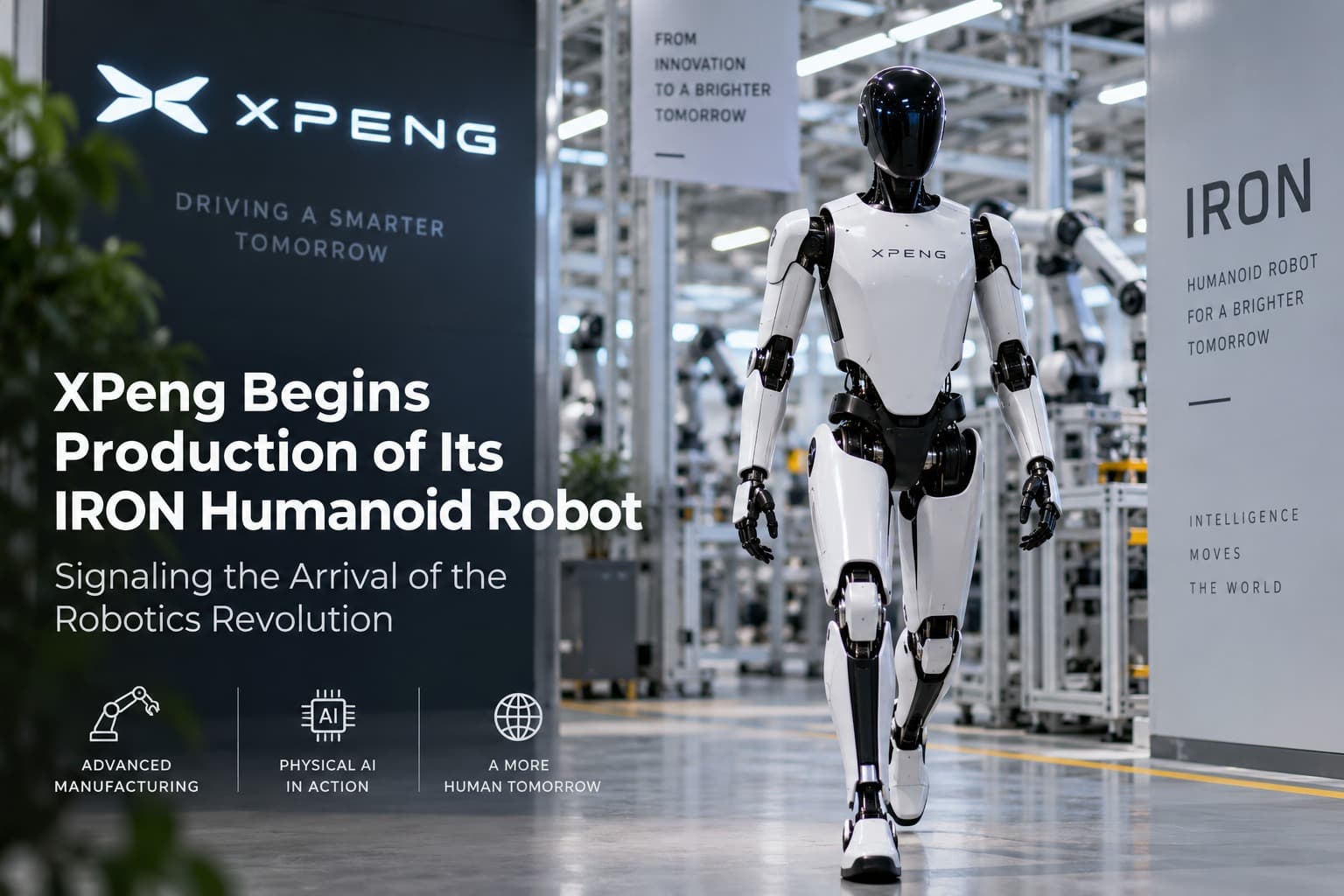
The Chinese EV and technology giant XPeng has now officially commissioned a production line for its IRON humanoid robot, the company stating that the facility has produced a finished product which was able to walk away on its own after completion.
On September 8, 2026, XPeng announced that its first IRON humanoid robot had left the newly commissioned production line and had walked away by itself. The company stated that the event signified its move from research and development to production-line manufacturing.
Although the manufacture of a humanoid robot on a production line might appear to be no more than another innovation or a fascinating technology demonstration, the really important point is that companies are now having to deal with the much more difficult question of whether these machines can be produced reliably, affordably and on a large scale. XPeng thinks that the answer to that question can be obtained using the IRON humanoid robot.
What Is XPeng's IRON Humanoid Robot?
Iron is XPeng's most recent innovation and one of the key components of the company's wider Physical AI strategy. The term "physical AI" is used to refer to AI which is not confined to functioning in a digital environment but instead appears in machines and is able to interact with the physical world.
A humanoid robot is a case of such machinery. Although other kinds of AI can function entirely within a digital environment, robots have certain physical limitations which have to be dealt with if they are to carry out useful work together with humans.
XPeng has designed its IRON humanoid robot to have a human-like structure and a wide range of motion in order to increase its flexibility and usefulness. The body of the robot has 76 degrees of freedom, which allows all of its joints and limbs to move independently. The robot's hand is the feature that receives particular attention, having 21 degrees of freedom per hand. They give an idea of the level of complexity involved in carrying out different tasks which demand fine motor skills and coordination.
Such considerations are important since, in addition to the obvious need for a robot to be able to move, its capacity to carry out a variety of tasks is crucial to maximizing its usefulness. A robot working in a factory or in a home environment will have to carry out more than just the action of going from point A to point B. To carry out the specified tasks it will have to reach, grasp, position, operate and manipulate objects and materials.
XPeng's IRON Humanoid Robot Has Entered the Production Line
The key background concern regarding the recent developments with XPeng's IRON humanoid robot is that the company has now started the manufacture of the robot on the production line.
In Guangzhou, China, the company celebrated the opening of its humanoid robot production plant by having a ribbon-cutting ceremony, during which an IRON robot was manufactured and then walked away from the production line by itself. The company has said that the event signified its move from R&D and prototyping to actual production-line manufacturing.
It is necessary to point out that although XPeng has already started the production-line work on the IRON humanoid robot, the company still expects mass production to begin later in 2026. The company also stated that the first commercial uses of the IRON robot would be in its own stores and campuses, with an official launch and wider market deliveries planned to start in China and other international markets in 2027.
That is to say, when the robot is first produced it shows that the launch will be slow and careful, rather than immediate, as in the case where tens or hundreds of thousands of units would be manufactured and delivered within a few months.
The significance of the milestone should by no means be overlooked, since it is one of the most important turning points in the development of any humanoid robot. The challenge that robotics developers face goes well beyond the huge amount of research and development investment required to produce a working prototype of any robot, since getting from prototype stage to production line and then to mass manufacturing presents a significantly greater difficulty.
More Than 80% of Production Line Processes Are Automated
A highly automated feature of XPeng's new production line for the IRON robot is perhaps the most interesting. XPeng states that over 80 per cent of the processes employed in the production line for the IRON robot are automated.
Because of its experience in making electric vehicles (EVs), the company has been able to use automation and other manufacturing methods to produce robots. It should also be pointed out that electric vehicles today are considerably more technologically advanced than they were a number of years ago, including a variety of cutting-edge technologies such as batteries, sensors, vision systems, electric drives, control and computer hardware and software, and other technologies.
This phenomenon is also evident in the robotics industry, since researchers and developers are combining similar and at times related technologies so as to allow robots to carry out useful tasks together with humans.
The automotive and robotics industries also have another important feature – moving from one-off or low-volume production to high-volume manufacturing involves the need for substantial process optimization and technical expertise. A robot which has been shown off on a conference stage or on a factory floor may be impressive, but it also has to be capable of carrying out each individual task reliably thousands of times over with only minimal maintenance or any other human interference.
The manufacturing process is often of the same importance as the technological innovation attained in the development of a robot. XPeng is trying to use its experience in making electric vehicles to assist it in dealing with the complicated production processes required to manufacture the IRON.
The Powerful AI "Brains" Behind the XPeng IRON
A robot of this type also needs a great deal of artificial intelligence (AI) processing power in order to function. The IRON humanoid robot from XPeng has been fitted with three of its Turing AI chips to give it a total processing power of 2,250 TOPS. This figure is used as an indication of the chip's performance, where TOPS stands for trillion operations per second. The power is needed in order to run the company's Physical AI foundational models on the robot.
This is yet another significant point in the development of robots, since the researchers are trying to strike a balance between the robot's use of processing power that is based in the cloud or that is available locally. The power available at the local level can be used to reduce latency and improve response rates, especially in the case of applications in which the robot has to carry out certain tasks. This is especially important in the case of a robot intended to operate in close proximity to humans, since response time can then become a vital factor.
The robot will also have to carry out complicated tasks which require a large amount of processing. For instance, the robot might have to recognise the objects and determine where they are in relation to itself, position its limbs so as to be able to reach or manipulate them, evaluate their weight and other properties and then make the appropriate adjustments to its movements. If these processes have to be carried out in real-time, they can become very computationally intensive.
The kind of delay that occurs during processing has a much greater impact when a robot is dealing with the physical world than it does in the case of an AI-driven chatbot.
Why Does the XPeng IRON Appear So Similar to a Human?
A highly noticeable design decision adopted by XPeng when producing the IRON is its strong focus on resembling humans. Even though the design might appear to be futuristic and imaginative, there is a very practical reason for it – namely that the human body is the most efficient design known to man.
It should also be pointed out that the human body is in fact the standard used for the design and measurement of most other machinery. The doors, stairs, shelves, tables, objects, factory workstations, switches and many other features of the built environment are made with human needs and capabilities in mind. The same principles may be applied to the design of robots. A machine similar to a human being can operate in the same environment as the person it corresponds to in order to increase its versatility and usefulness. One of the reasons why companies all over the world are putting a great deal of resources into the development of humanoid robots is this.
The human design is also extremely challenging to replicate mechanically. A robot must be able to perform complex motions needed to carry out tasks while also being able to avoid potentially hazardous obstacles or conditions. The robot must also be able to balance itself at all times, particularly when using two legs to move around. The complexity is amplified when fine motor skills are needed. The 76 degrees of freedom incorporated into the XPeng IRON represent the necessary mechanical complexity needed to perform various tasks.
Where Will XPeng Use Its IRON Humanoid Robot?
It is important to note that the first applications for XPeng's IRON humanoid robots are likely to be found within its own commercial ecosystem. The company has indicated that its first commercial applications for the IRON are likely to be found within its own stores and campuses, with broader market deliveries to commence in China and other international markets in 2027.
This approach is not unusual, as it enables the developer to better understand the requirements and challenges of operating the robot in a specific environment. It also enables the company to observe the performance of the robot under controlled conditions, where fewer variables need to be taken into account.
There are numerous potential applications for a robot within a commercial retail environment, ranging from providing assistance to customers to carrying out specific tasks. Factory settings can also be utilized as an option for early applications, with the potential for the robot to perform basic functions or serve as an assistant.
The key consideration in any application setting is the robot's ability to perform its intended tasks reliably and consistently. A robot that can perform for five minutes in a factory or office setting is an interesting technological novelty, but it also needs to be able to operate reliably for much longer intervals with minimal maintenance or human intervention in order to be commercially viable. This is the test that XPeng's IRON will have to pass in order to maximize its commercial viability in the long run.
XPeng Is Heavy Into Robotics
The IRON humanoid robot is not the only focus of XPeng's robotics strategy, which has seen the company invest substantial resources into the development of machines that can operate in tandem with humans and perform useful work.
The company announced in late August 2026 that its robotics business has raised more than $900 million in its first external financing round. The figures indicate that XPeng's robotics business was valued at more than $6.3 billion after the investment closed. Reuters notes that the investment represents the largest single private funding in China's embodied-AI sector.
XPeng indicated that the fundraising will accelerate the development of the company's robotics technology, including hardware and software, Physical AI model training, high-quality data generation, mass-production infrastructure and global expansion.
The investment is further indication that the robotics industry is beginning to transition from a niche research and development area into a mainstream technology sector. Companies are beginning to recognize the strategic importance of robotics, including their potential role in future economic development as well as their ability to serve as enablers of broader technological advances. The investment by XPeng also indicates the technical and financial challenges associated with robot development, particularly at the later stages when the focus shifts from R&D to high-volume manufacturing.
Why Are Car Manufacturers Getting Into Robotics?
At first glance, it may seem surprising that an electric vehicle (EV) manufacturer would get so deeply involved in the development of humanoid robots. However, a closer inspection of the trends indicates that the two areas are linked in several important ways.
Modern EVs are already effectively robots, albeit simplified ones. They incorporate a variety of technologies that are also used in robotics, including cameras and other sensors, computer hardware and software, artificial intelligence (AI), control systems and electric drives. The latter technology is particularly important, as it enables the EV or robot to effectively carry out physical tasks.
Reuters notes that automakers are also keen to develop robotics due to the potential overlap between the two fields in terms of sensors, software, batteries and supply chains.
XPeng is not the only car manufacturer to get into robotics, as Tesla is also working on its Optimus humanoid robot, while Hyundai-owned Boston Dynamics continues to develop the Atlas. Meanwhile, Chinese automakers are also investing significantly into the development of humanoid robotics. The competition within the industry is beginning to intensify, with manufacturers looking to gain an early advantage. The ability to scale production of these machines is also likely to be a decisive factor.
Humanoid Robotics Is Set to Be One of 2026's Main Stories
The developments involving XPeng's new IRON humanoid robot mark one of the most exciting stories of 2026. However, they also come on the heels of another major development in the industry, with Reuters publishing an article on China's burgeoning humanoid robotics ecosystem and the TianGong platform a few days ago.
The TianGong Ultra humanoid robot has been able to showcase incredible speed and agility, while researchers and developers are also working to bring the technology to more practical applications.
The industry as a whole has moved beyond the question of whether it is possible to build a humanoid robot and has turned its attention to maximizing its utility. This is an extremely challenging proposition, as it involves ensuring that the machine can work reliably while fulfilling a variety of tasks that previously required human effort. A robot that can walk and run is one thing, but a machine that can be relied upon to perform useful tasks on a regular and ongoing basis is quite another. The transition from one to the other will define the next stage of the development of humanoid robotics.
Boston Dynamics Is Finding That Scaling Production Is a Challenge
Another important development in the world of robotics this month involves Boston Dynamics, which is seeing the challenges that manufacturers are facing when attempting to scale production of humanoid robots.
Reuters published a report on September 14 that indicated that Hyundai Motor Group is seeking to establish a dedicated production facility that would be capable of manufacturing 30,000 robots per year by 2028. The first humanoid units from the project are set to roll off the assembly line at Hyundai's Georgia plant in the United States.
However, the report also indicates that analysts are beginning to realize that it is much more challenging to get these machines to perform useful tasks than it was to get them to walk. This is another illustration of the reality that a viral video of a robot performing impressive feats is not necessarily an indicator of its overall commercial viability.
The next few years will see the industry wrestle with the practical aspects of turning humanoid robotics into viable commercial products.
The Real Challenge Involves Getting Humanoid Robots to Perform Useful Tasks
While the image of the robot walking away from the production line may generate more headlines, it is important to remember that it is closer to the beginning than the end of the road for humanoid robotics. The real challenge for manufacturers such as XPeng lies ahead and involves maximizing the utility of the robot.
Some of the most pertinent questions in this regard include the following:
Can the robot perform useful tasks? A robot must be able to perform a variety of tasks in order to realize its potential. A humanoid robot is not useful simply because it looks human or is capable of walking on two legs. It must be able to operate machinery and perform various tasks as well.
Can the robot perform reliably? This factor is critically important to all manufacturing and operations, as reliability directly impacts cost and efficiency. Most robots require a certain amount of maintenance, but the more frequently they require human intervention, the less economical they are.
How much will the robot cost? This factor directly impacts the robot's application and potential market. XPeng has not indicated how much the IRON will cost, but it is safe to assume that the price will determine which industries will be able to adopt the technology.
Can the robot scale? Manufacturing hundreds of sophisticated robots is one challenge, but manufacturing thousands or hundreds of thousands on a regular basis represents another level of difficulty altogether.
How autonomous is the robot? A truly useful general-purpose robot must be able to function in a variety of environments without requiring extensive human input.
These are the questions that manufacturers will have to answer in due course, as they seek to maximize the commercial viability of their respective robots.
Can Humanoid Robots Enter Our Homes?
In theory, humanoid robots have the potential to enter our homes and assist with a variety of tasks. However, it is much more likely that they will initially be deployed within factory and commercial settings.
The reason for this is simple – these environments are much more structured and predictable than a home. A home can contain a variety of pets, toys, furniture, objects, stairs and other elements that must all be taken into account when operating a robot. Meanwhile, a factory setting can be made to be much more predictable, with standardized elements in a specific location.
Once the technology is more mature and the cost is lower, it may be possible for humanoid robots to enter the home environment. However, this will be a slow process that will unfold over several years.
What Does It All Mean for the Future of Robotics?
The developments surrounding XPeng's new humanoid robot highlight the long road that lies ahead for robotics developers and manufacturers. For several decades, humanoid robotics was a niche field of research that saw occasional breakthroughs but did not see any major commercial applications because of the technical and economic challenges involved in manufacturing such machines.
Now, companies are beginning to take the long-term view and invest substantial resources into the development of robot manufacturing infrastructure. In many ways, the industry is transitioning from prototype to product, and eventually, to mass-market product. XPeng's highly automated robotics production line is one step towards that goal. However, it will take time for the company to demonstrate the robot's reliability and commercial viability.
China Is Emerging as a Global Robotics Power
Another factor that must be considered when discussing the future of humanoid robotics involves China's role in the industry. China's electronics and robotics manufacturers benefit from having one of the world's most extensive supply chains for many types of machinery, electronics and other components. Motors, batteries, sensors, control systems, processors, computers and various other elements can be sourced from a wide range of suppliers within the country. China also plays a major role when it comes to embodied artificial intelligence (AI).
The investment by XPeng that was announced last month represents yet another indicator of the growing interest in robotics on both a national and corporate level. The competition among robotics developers will also play a role in driving the industry forward, with manufacturers vying to develop superior actuators, batteries, AI technologies and manufacturing processes. This competition will ultimately lead to lower prices, enabling humanoid robotics to eventually become much more mainstream than they are likely to be in the early part of this decade.
It is also worth noting that the adoption and affordability patterns of many technologies tend to follow a similar progression. Products that are prohibitively expensive at the cutting edge of innovation eventually become much more accessible as supply chains are optimized and new manufacturing techniques are developed. Humanoid robotics are likely to undergo a similar transformation, although the timeline in that regard is still uncertain.
What Comes Next for XPeng's IRON Humanoid Robot?
The remainder of 2026 is set to be particularly crucial for XPeng and its IRON humanoid robot, as the company is set to begin its mass production of the robot later this year. The company has indicated that commercial applications for the robot are set to begin within its own stores and campus. In 2027, XPeng is set to officially launch the robot and begin its broader market deliveries in China and other international markets.
The coming months and years will be critical for the robot, as XPeng will have to address a number of important questions, including the following:
- How much will the robot cost?
- How reliable is it?
- What specific tasks will it perform?
- How much can XPeng scale its production rates?
- How much human intervention will be required in its operation?
- Will it be valuable enough for businesses to adopt on a broader scale? These are the questions that will determine whether XPeng's IRON will eventually become a truly viable commercial product.
Final Thoughts: Humanoid Robotics Entering a New Era of Development
The image of XPeng's IRON robot walking away from its production line is an appropriate one, as it marks the beginning of a new era for humanoid robotics. For years, these machines have been seen on factory floors, conference stages and in viral online videos. However, they are now beginning to show up in production facilities that are specifically designed to turn them out in larger numbers.
XPeng's new robotics production facility, which has more than 80% of its processes automated, is one such example. The company is looking to transition the development of its IRON humanoid robot from the realm of research and prototyping into that of a repeatable manufacturing process. The robot still has a long way to go before it can be considered truly viable, as the company will need to address the challenges of scaling its production processes and maximizing the robot's utility.
While XPeng plans to begin its mass production of the robot later this year and commence its broader commercial deliveries in 2027, the fundamental questions regarding the robot's cost, reliability and overall usefulness will continue to linger.
That said, it is becoming increasingly apparent that the development of humanoid robotics is entering a new stage, with companies such as Tesla, XPeng, Hyundai and Boston Dynamics, as well as numerous Chinese robotics companies and research institutes, pushing the industry to make these machines much more commercially viable.
The most important competition may no longer be centered on which company can get its robot to look most like a human. Instead, it may be about which firm can develop a machine that is intelligent enough to be truly useful.
XPeng has embarked on this journey and has positioned itself to be a major player in the future robotics landscape. 2027 may very well be the year when industry observers realize that humanoid robots are set to become much more than just interesting technological curiosities.