
Robotic Sir Blog
Vision-Language-Action Models: The Next Brain for Robots
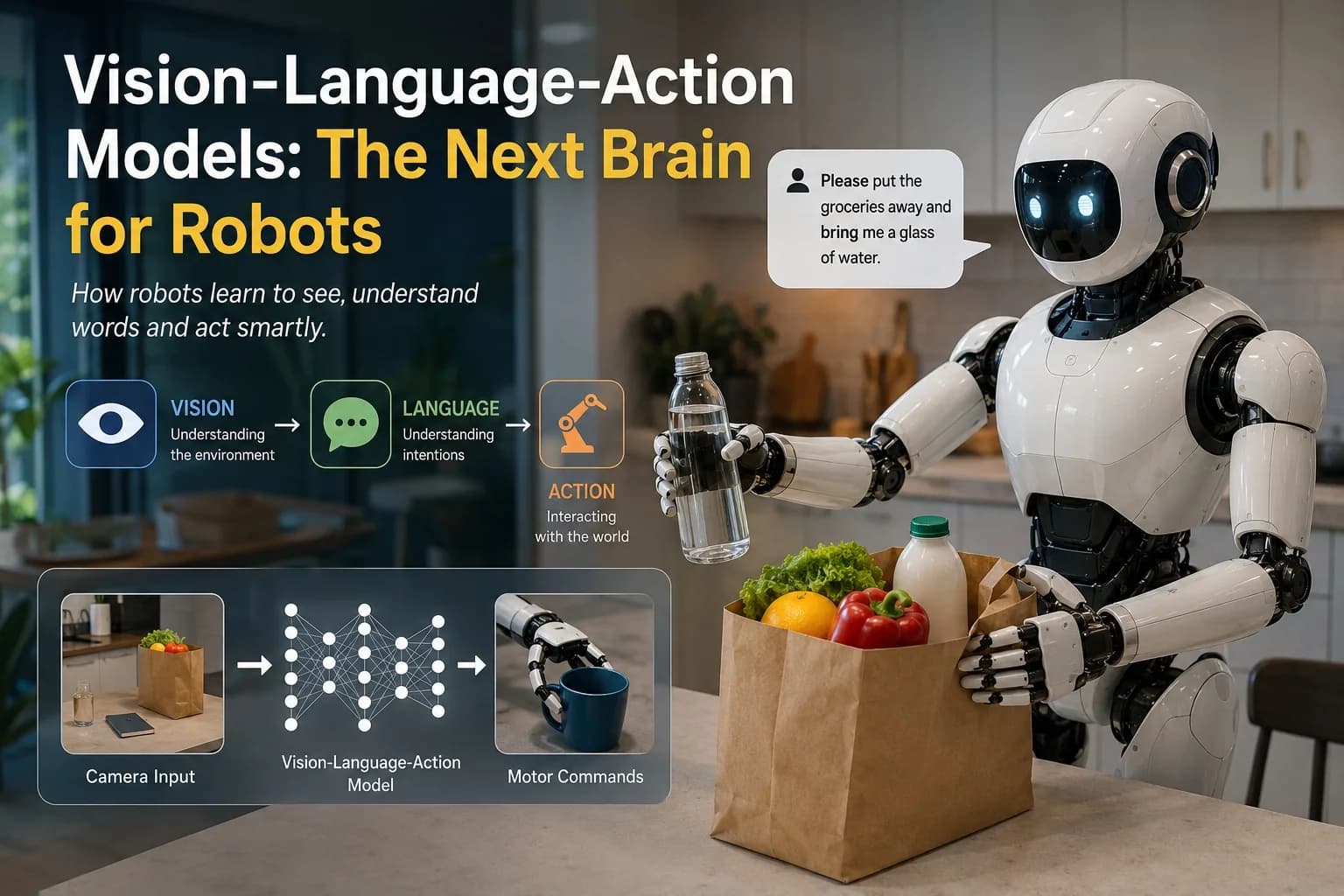
How robots learn to see, understand words and act smartly.
Imagine walking into your kitchen after a day and saying, "Please put the groceries away and bring me a glass of water.”
A robot standing nearby looks at the kitchen counter, sees the grocery bags, knows where each item should go and starts to organize them. It sees a glass bottle lifts it gently and moves around a chair that someone left in the way.
You did not write any code for this situation. You did not explain every movement. Program the robot to recognise the exact objects on your counter.
You simply asked it to help.
For years this kind of interaction was mostly found only in science fiction.
Traditional robots were very good at doing tasks but they had trouble when the environment changed or when instructions were unpredictable.
Now a new way of intelligence is helping researchers build robots that can understand what people want and find a way to act.
That technology is called Vision-Language-Action (VLA) models.
VLA models are an advance in robotics because they link three abilities that smart machines need: seeing their surroundings, understanding instructions and performing physical actions.
How do these models actually work? What makes them different from robotic systems? Can they become the base for general-purpose robots?
Let’s explore.
What Are Vision-Language-Action Models?
A Vision-Language-Action model is an intelligence system that turns visual information and natural-language instructions into actions that a robot can do.
The idea becomes easier to understand when we split it into its three parts.
Vision: Understanding the environment
Vision lets the robot look at its surroundings using cameras and other sensors.
It can see a coffee mug on a table, spot a drawer, guess where a moving person is or find out which objects block its path.
Seeing an object is only part of the challenge. The robot also needs to know the objects location orientation. How it relates to nearby objects.
Language: Understanding intentions
Language processing lets robots understand instructions written in ordinary words.
Then needing complex programming commands a person might say, "Pick up the red bottle and place it beside the laptop.”
The robot must know which object is mentioned, what action is requested and where the object should go.
Action: Interacting with the world
Action is where VLA models become especially interesting.
Unlike AI systems that only describe images or write text VLA models produce outputs that can guide a robot’s movement.
These outputs may show positions, gripper movements or other motor control commands.
In terms: Vision tells the robot what is happening. Language tells the robot what must be done. Action lets the robot do something about it.
That link makes VLA models an important part of the emerging field of Physical AI.
Why Traditional Robots Struggle With Everyday Tasks
Industrial robots have changed manufacturing for decades.
Walk into an automobile factory and you will see robotic arms welding car bodies assembling parts and doing precise operations thousands of times.
These machines are fast, reliable and very accurate when they work in their designed conditions.
Why can’t the same robot clean a messy bedroom easily?
The answer is flexibility.
Traditional robotic systems often rely on set instructions, controlled environments and special programming.
For example a robotic arm on an assembly line may be programmed to pick a component from a spot and put it into a machine.
Long as everything stays the same the system works well.
What happens if someone moves the component?
What if the object is turned?
What if the robot meets a component that does the same job?
A conventional system may need extra sensors, new programming or a separate detection algorithm.
Every unexpected situation creates another engineering challenge.
Humans handle these variations without effort.
We recognise objects even when they are, in positions. We change our grip when something starts slipping. We understand instructions without needing every movement explained.
I see that researchers want robots to develop flexibility.
Vision-Language-Action models offer an approach. By allowing robots to learn relationships between observations, human instructions and physical movements Vision-Language-Action models let robots avoid relying entirely on manually programmed rules.
This does not eliminate robotics. Precise control systems, motion planning and safety mechanisms remain essential.
Instead Vision-Language-Action models provide a more adaptable intelligence layer above or alongside those systems.
How Do Vision-Language-Action Models Work?
Let us imagine an arm sitting beside a table containing three objects: a red apple, a blue cup and a small notebook.
A person gives the instruction: "Pick up the apple and put it inside the basket.”
For a human this sounds simple.
For a robot several things must happen.
Step 1: The Robot Observes Its Surroundings
First the robot receives information from its camera.
The image contains the table, objects, basket and surrounding environment.
A vision encoder processes this information and converts it into numerical representations that the Vision-Language-Action models can use.
These representations help the Vision-Language-Action models identify features and relationships within the scene.
For instance it needs to distinguish the apple, from the cup and understand the baskets position.
Some robotic systems also use depth cameras, joint-position sensors or other information to improve understanding.
Step 2: The Model Interprets the Instruction
“Pick up the apple and put it inside the basket.”
The language component helps connect the words to the visual scene.
The model needs to associate “apple” with the correct object and understand that “inside the basket” describes the desired destination.
This process is often called visual grounding.
Visual grounding is important because the same instruction can mean different things depending on the environment.
For example, “move the cup to the left” requires the robot to understand which cup is being discussed and what “left” means in the current context.
Step 3: The Model Generates an Action
Once the model has processed the scene and instruction, it produces an action representation.
Depending on the system, this might include target movements for the robot's arm, wrist, and gripper.
Some models generate sequences of actions, sometimes called action chunks, instead of predicting only one movement at a time.
The robot's control system then converts those predictions into suitable motor commands.
Step 4: The Robot Executes the Movement
The robotic arm moves toward the apple, positions its gripper, and attempts to grasp it.
It then transports the apple toward the basket and releases it.
The physical execution still depends on the robot's mechanical design, motor controllers, sensors, and safety limits.
A powerful AI model cannot compensate for every mechanical limitation.
Step 5: The Robot Observes and Adjusts
Real-world environments rarely behave exactly as expected.
The apple might shift while being grasped. The basket could move. Another object might obstruct the arm.
A robot can use fresh camera observations and sensor feedback to update its actions.
This repeated observation-and-action process helps the system respond to changes rather than blindly executing an entire sequence.
The overall process can be summarized as:
Camera Input → Visual Understanding → Language Interpretation → Action Prediction → Robot Movement → Feedback
Although the process sounds straightforward, making it reliable across thousands of objects and unpredictable environments remains a major research challenge.
VLA Models vs Traditional AI Models: What's the Difference?
Artificial intelligence includes several model categories, and their names can sound confusing.
Three particularly important categories are Large Language Models, Vision-Language Models, and Vision-Language-Action Models.
Large Language Models (LLMs)
Large Language Models are primarily designed to process and generate language.
They can answer questions, summarize documents, write programs, and help solve problems.
However, a language model does not automatically know how to control a robotic arm.
It may describe how to pick up a bottle, but that explanation is not the same as producing reliable motor commands.
Vision-Language Models (VLMs)
Vision-Language Models extend AI capabilities by connecting images and text.
They can examine a photograph, identify objects, answer questions about a scene, or explain visual relationships.
For example, a VLM might identify a screwdriver lying beside a laptop.
But recognizing the screwdriver does not necessarily mean the model can physically pick it up.
Vision-Language-Action Models (VLAs)
VLA models take the next step by connecting visual understanding and language instructions to robotic actions.
A VLA-equipped robot could potentially identify the screwdriver, interpret a request to retrieve it, and generate movements to grasp it.
| AI Model | Primary Capability | Example |
|---|---|---|
| LLM | Understands and generates language | Explains how to assemble a robot |
| VLM | Understands images and language | Identifies robot components in a photograph |
| VLA | Connects vision and language to physical actions | Guides a robot to pick up a component |
This distinction is important.
A chatbot can explain a task. A vision-language model can observe the task environment. A VLA model aims to help a physical machine carry out the task.
That doesn't make VLA models universally more intelligent. Each category solves different problems.
Their significance comes from bringing AI closer to direct interaction with the physical world.
Real-World Examples of Vision-Language-Action Models
VLA technology is no longer limited to theoretical research.
Several major robotics and AI organizations are developing models designed to improve robot learning and physical interaction.
1. Google DeepMind: Gemini Robotics
Google DeepMind has been exploring how its multimodal AI research can support robotic intelligence.
Its Gemini Robotics family connects visual understanding, language instructions, reasoning, and robot control.
In July 2026, Google introduced Gemini Robotics 2, expanding its research toward whole-body humanoid control, dexterous manipulation, and collaboration between robots.
The company also developed embodied-reasoning models that can help robots interpret complicated environments and plan multi-step tasks.
This distinction matters because completing an everyday activity may require both high-level planning and precise physical movement.
Consider cleaning a cluttered room.
A robot must identify which objects belong where, decide which task to perform first, navigate around obstacles, and manipulate objects without damaging them.
Such activities require much more than object detection.
Google's work illustrates how reasoning systems and action models can complement each other.
2. NVIDIA: Isaac GR00T
NVIDIA is another major contributor to the development of general-purpose robotic intelligence.
Its Isaac GR00T platform focuses on robot foundation models, simulation, data generation, and development tools.
A major challenge in robotics is collecting enough training data.
Unlike text-based AI, which can learn from large collections of digital documents, physical robots often need demonstrations involving actual movements and interactions.
Gathering those demonstrations can be expensive and time-consuming.
NVIDIA's robotics ecosystem addresses parts of this challenge through simulation and tools that support training and evaluation.
Its work is particularly relevant to humanoid robots, which must coordinate multiple joints, balance, perception, and manipulation.
3. Physical Intelligence: The π Model Family
Physical Intelligence is developing robot foundation models intended to learn a broad range of physical skills.
Its π model family explores how one model architecture can support different manipulation tasks and robotic platforms.
This direction is significant because many traditional robotic systems are trained for narrowly defined tasks.
A more general-purpose model could potentially transfer knowledge between activities, reducing the need to build a separate AI system for every operation.
Imagine a robot learning how to fold a towel and then using some of that manipulation knowledge to handle other flexible objects.
The tasks are different, but they share useful physical concepts.
Generalizing across these experiences is one of the central goals of modern robot learning.
4. Figure AI: Humanoid Robot Intelligence
Figure AI is working on humanoid robots designed to operate in human environments.
Its Helix model family explores vision-language-based robotic control and increasingly integrated whole-body behavior.
Humanoid robotics presents unique challenges because robots must coordinate perception, balance, arm movement, and hand manipulation.
Picking up an object while standing may require adjustments throughout the robot's body.
Developments in humanoid intelligence highlight why action models need to understand more than the movement of a single robotic arm.
They must account for the interaction between the robot's body and its surroundings.
How Are VLA Models Trained?
One of the most fascinating questions in robotics is how a machine learns to perform physical tasks.
For VLA models, training commonly involves combinations of visual observations, language instructions, and examples of robotic actions.
Researchers use several approaches.
Learning From Human Demonstrations
One common technique is imitation learning.
A human demonstrates a task, and the system records information such as camera images, robot states, and corresponding movements.
For example, a person might remotely control a robotic arm to pick up a cup and place it on a shelf.
The recorded demonstration becomes training data.
After observing many examples, the model learns patterns that connect particular situations with useful actions.
However, imitation learning has limitations.
If the training data does not include enough variation, the robot may struggle with unfamiliar situations.
Learning Through Simulation
Simulation provides another way to train robots.
Instead of performing every experiment using physical hardware, researchers create virtual environments where robots can practice movements.
A simulated robot might attempt thousands of grasping actions with different objects, positions, and lighting conditions.
Simulation can accelerate experimentation and reduce hardware wear.
However, virtual environments never perfectly reproduce the real world.
Differences in friction, object weight, sensor noise, and physical contact can cause a model that works in simulation to fail on actual hardware.
This is known as the sim-to-real gap.
Learning Across Different Robots
Another research direction is cross-robot learning.
Instead of training an AI model for only one robotic arm, researchers investigate whether shared models can learn from multiple robot types.
A model might be trained using demonstrations from robots with different grippers, arm lengths, and joint configurations.
The challenge is that each robot has its own physical capabilities.
An action suitable for a six-axis industrial arm may not directly translate to a humanoid hand.
Researchers therefore explore representations and adaptation techniques that allow learned behavior to transfer between different robotic bodies.
This ability could eventually make robot training more efficient and scalable.
Why Vision-Language-Action Models Matter for Physical AI
The term Physical AI describes artificial intelligence systems that interact with the physical world.
Unlike software that operates entirely through screens, documents, or digital services, Physical AI must deal with gravity, motion, contact, uncertainty, and physical consequences.
A robot cannot simply generate a convincing answer when a task goes wrong.
If it drops a glass, the glass may break.
If it moves incorrectly near a person, someone could get hurt.
If it misjudges an object's weight, its motors may struggle or its gripper may lose control.
This makes robotics fundamentally different from many digital AI applications.
VLA models matter because they aim to connect flexible AI reasoning with real physical behavior.
They could help robots move beyond rigid automation toward systems capable of handling greater environmental variation.
However, the word “intelligent” should not be confused with “infallible.”
Even advanced models can misinterpret instructions, fail to recognize unusual objects, or generate actions that are unsuitable for a particular situation.
Reliable Physical AI requires a combination of machine learning, mechanical engineering, sensors, control theory, and safety engineering.
The future of robotics will likely depend on how successfully these disciplines work together.
Real-World Applications of Vision-Language-Action Models
The potential applications of VLA technology extend across industries.
Some are already being explored in research laboratories, while others remain longer-term possibilities.
Manufacturing and Industrial Automation
Factories are natural environments for robotic automation.
VLA-based systems could make industrial robots more adaptable to variations in parts, layouts, and assembly tasks.
Instead of manually programming every new operation, engineers may eventually be able to describe tasks using natural language and provide demonstrations.
For example, a robot could be instructed to identify a particular component, pick it up, and place it in an assembly fixture.
This could be especially useful in manufacturing environments where products change frequently.
Healthcare and Assistive Robotics
Healthcare is another area where adaptable robotic systems could provide benefits.
Assistive robots might help retrieve everyday objects, transport supplies, or support people with limited mobility.
A person could potentially ask a robot to bring a water bottle from a nearby table.
The robot would need to identify the correct object, navigate safely, and deliver it.
However, healthcare environments demand exceptionally high reliability.
VLA systems intended for these settings would require extensive testing, safeguards, and appropriate human supervision.
Warehouses and Logistics
Warehouses contain a wide variety of objects, packaging materials, and storage arrangements.
Traditional automation performs well when products and positions are predictable.
VLA models could help robots handle a wider range of objects without requiring a separate program for every product.
Potential tasks include sorting parcels, retrieving items, organizing shelves, and assisting with order fulfillment.
Agriculture
Agricultural environments are difficult because plants, fruits, lighting, and terrain vary constantly.
A robot harvesting fruit must recognize which fruit is ready, estimate its position, and handle it without causing damage.
Combining visual understanding with adaptive manipulation could help agricultural robots perform these tasks more effectively.
Household Robotics
Home robotics is one of the most exciting possibilities.
Imagine a robot that can organize a desk, collect laundry, or put away everyday objects.
Homes are unpredictable environments filled with objects that differ in shape, size, and location.
This makes household robotics an especially difficult challenge.
VLA models may provide part of the intelligence needed, but reliable household assistants will also require affordable hardware, strong safety systems, and robust manipulation skills.
The Biggest Challenges Facing VLA Models
Despite rapid progress, several problems must be solved before VLA-powered robots become widely practical.
1. Limited training data
Collecting robot demonstrations is much harder than gathering text or images from the internet.
Physical experiments require equipment, time, maintenance, and careful supervision.
2. Unpredictable environments
Real-world conditions change constantly.
Lighting, object placement, slippery surfaces, and unexpected human movement can all affect performance.
3. Computational requirements
Advanced AI models may require substantial computing power.
Robots must often make decisions quickly, which creates challenges involving latency, power consumption, and onboard processing.
4. Physical safety
An incorrect prediction can cause a robot to collide with equipment, damage objects, or injure people.
Independent safety mechanisms remain essential.
5. Generalization
A robot that performs well on familiar objects may fail when encountering a different shape, material, or arrangement.
Researchers are working to improve performance across unfamiliar tasks and environments.
6. Cost and accessibility
Sophisticated robotic platforms, high-quality sensors, and computing hardware can be expensive.
Making VLA technology accessible to smaller laboratories, students, and developers will be important for wider adoption.
These challenges explain why impressive demonstrations should not be mistaken for proof that general-purpose robots are ready for every home or workplace.
Can Students and Developers Build VLA-Based Robots?
One encouraging aspect of modern robotics is the growing availability of open-source tools and research resources.
Students interested in Vision-Language-Action models do not necessarily need to begin with an expensive humanoid robot.
A small robotic arm can provide an excellent introduction.
Consider a student project involving a camera, a robotic gripper, and an AI-based object recognition system.
The user gives a command:
“Pick up the blue block and place it in the left container.”
The camera identifies the objects.
A language-processing component interprets the instruction.
The system determines the target object and destination.
A controller generates the required movements, and the robotic arm performs the task.
This would be a useful educational example of connecting vision, language, and robotic action.
However, it is important to distinguish such a modular project from a genuine end-to-end VLA model.
A system that combines an object detector, a language model, and manually programmed movements is not automatically a VLA foundation model.
A true VLA model learns to generate robotic actions from visual observations and language instructions.
For students who want to explore the field, useful technologies include Python, PyTorch, OpenCV, ROS 2, simulation tools, and publicly available robot-learning datasets.
Platforms such as LeRobot and open research implementations can provide a starting point for experimenting with imitation learning and robot policies.
The best approach is to begin with a simple manipulation task, understand the control pipeline, and gradually introduce learning-based methods.
Even a small prototype can teach valuable lessons about perception, motion planning, feedback, and the difficulties of physical interaction.
Will VLA Models Replace Traditional Robot Programming?
It is tempting to imagine a future where engineers simply tell robots what to do and never write motion-control code again.
Reality is likely to be more complicated.
Traditional robotics provides important advantages, including predictable behavior, precise control, and well-understood safety mechanisms.
These qualities are essential in applications such as industrial manufacturing, medical devices, and high-speed automation.
VLA models offer flexibility, but their outputs can be uncertain.
A practical robotic system may therefore combine both approaches.
The VLA model could interpret the task and generate desired actions, while conventional controllers handle motor-level execution, stability, collision avoidance, and safety constraints.
For example, a robot might use a VLA model to understand which object should be picked up.
A motion planner could then calculate a safe path, while a low-level controller manages the motors.
This combination could provide a useful balance between adaptability and reliability.
Rather than replacing traditional robotics, VLA technology may become another powerful tool in the robotics engineer's toolkit.
The Future of Vision-Language-Action Models
Looking ahead, one of the most important goals is developing robots that can learn many tasks instead of being limited to a small number of predefined operations.
Researchers are exploring larger and more diverse training datasets, improved action representations, simulation-based learning, and models that can adapt to different robot bodies.
Another important direction is on-device intelligence.
Robots operating in homes, hospitals, or factories cannot always depend on a fast internet connection.
Efficient models that run directly on robotic hardware could improve responsiveness and reduce reliance on cloud processing.
Multi-robot collaboration is also becoming an interesting research area.
Imagine two robots working together to move a large object or organize a shared workspace.
They would need to coordinate their actions, understand each other's movements, and respond to changing conditions.
Future systems may also combine VLA models with stronger spatial reasoning, tactile sensing, and long-horizon planning.
These capabilities could help robots perform more complicated activities that involve many steps and require continuous adjustment.
Still, progress is unlikely to happen overnight.
Building robots that are useful, safe, affordable, and reliable across everyday environments remains an enormous engineering challenge.
The most meaningful advances will be measured not only by impressive demonstrations but also by consistent performance outside controlled laboratories.
Conclusion: The Next Brain for Robots Is Taking Shape
For years, robotics has faced a difficult question:
How do we create machines that can do more than repeat the same programmed movements?
Vision-Language-Action models offer one of the most promising answers.
By connecting visual perception, natural-language understanding, and physical action, these models are helping researchers develop robots that can respond more flexibly to human instructions and changing environments.
Their potential reaches far beyond humanoid robots.
Industrial arms, assistive devices, agricultural machines, warehouse systems, and research platforms could all benefit from more adaptable robotic intelligence.
But the journey is only beginning.
Reliable robot learning still faces major challenges involving training data, computational efficiency, safety, and real-world generalization.
The next generation of robotics will not be defined by AI models alone. It will emerge from the combination of intelligent software, carefully engineered hardware, and reliable physical control.
Perhaps the most exciting possibility is not that robots will suddenly become human-like.
It is that interacting with robots could gradually become more natural.
Instead of learning a machine's complicated programming language, people may increasingly be able to explain what they need in their own words.
And the robot, using its cameras, intelligence, and mechanical capabilities, may be able to turn those words into meaningful action.
That is the real promise of Vision-Language-Action models: moving artificial intelligence beyond understanding the world and toward helping us interact with it.
Frequently Asked Questions (FAQs)
1. What is a Vision-Language-Action model?
A Vision-Language-Action model is an AI system that processes visual observations and natural-language instructions to generate robotic actions. It helps connect perception and language understanding with physical movement.
2. How are VLA models different from ChatGPT?
ChatGPT primarily interacts through language and other supported digital inputs and outputs. VLA models are specifically trained to produce actions for physical robotic systems based on visual information and instructions.
3. Are VLA models used in humanoid robots?
Yes. Researchers and companies including Google DeepMind, NVIDIA, and Figure AI are developing robotic intelligence systems that incorporate vision, language, and action capabilities for humanoid and other robotic platforms.
4. Can VLA models work without an internet connection?
Some models are designed for local execution on robotic devices. However, their hardware requirements and capabilities vary, and many advanced research systems still require powerful computing resources.
5. What is the future of Vision-Language-Action models?
The long-term goal is to create robots that can understand instructions, learn different physical skills, adapt to unfamiliar environments, and safely perform useful tasks with less task-specific programming.