
Robotic Sir Blog
Physical AI: How AI Is Giving Robots the Ability to See, Think and Act
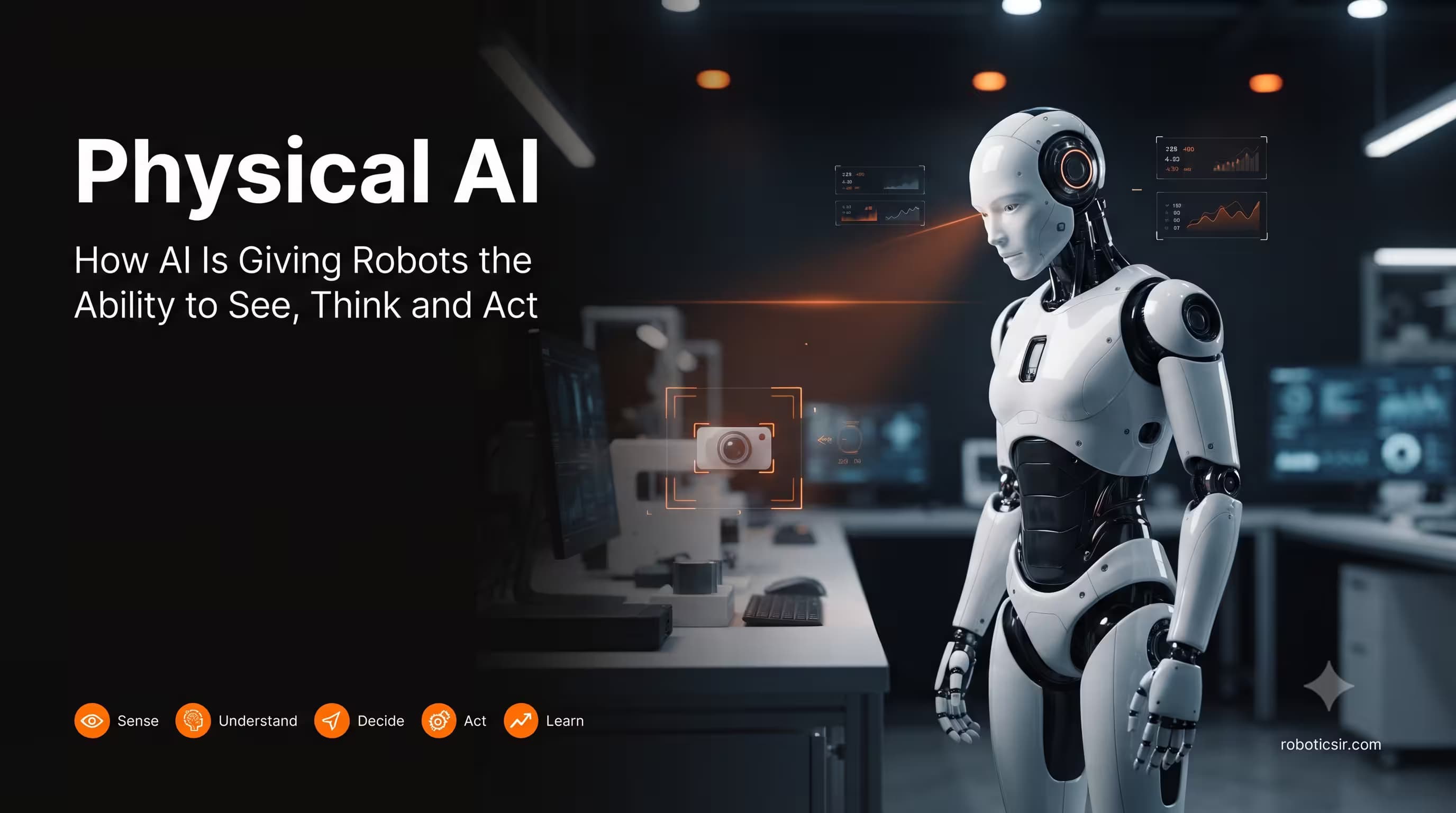
Artificial Intelligence has already changed the way we use technology. We have AI chatbots that can answer questions, AI tools that can create images and videos, and systems that can understand speech.
But what happens when AI gets a physical body?
This is where Physical AI comes in.
Physical AI is becoming an important concept in modern robotics because it allows AI systems to interact with the real world through robots, autonomous machines, drones and other physical systems. Instead of only processing information on a screen, these systems can observe their surroundings, make decisions and perform physical actions.
As a BCA student interested in AI and robotics, I find this especially interesting because it connects two areas that are usually taught separately: software intelligence and hardware interaction.
What Is Physical AI?
In simple words, Physical AI is AI that can understand and interact with the physical world.
A normal AI model might look at an image and identify a cup. A Physical AI system could use a camera to detect that cup, understand where it is, plan how to pick it up, and then control a robotic arm to actually grab it.
The basic process looks something like this:
Sense → Understand → Decide → Act → Learn
Physical AI combines AI models with technologies such as:
- Cameras and computer vision
- Sensors
- Machine learning
- Robotics
- Motors and actuators
- Control systems
- Simulation
- Real-time computing The International Telecommunication Union describes embodied AI as AI integrated into physical systems that can interact with and adapt to the physical world.
How Is Physical AI Different From Traditional Robotics?
Traditional robots are often designed to perform specific tasks using predefined instructions.
For example, an industrial robotic arm might repeatedly pick up the same component and place it in exactly the same location.
That works extremely well in controlled environments.
But the real world is messy.
Objects can move. Lighting can change. People can walk into the robot's workspace. Objects can have different shapes and weights.
This is where AI can make robots more adaptable.
Instead of programming every possible situation manually, researchers are developing AI systems that allow robots to learn from data, demonstrations and interaction with their environment. Stanford's 2026 AI Index notes that physical-world robotics is particularly challenging because environments are unpredictable and mistakes have real physical consequences.
How Do Robots "See"?
A robot doesn't literally see like a human.
It uses sensors.
Cameras can provide visual information about the environment, while depth cameras, force sensors and other sensors can provide additional information.
For example, imagine a robot being asked:
"Pick up the red bottle from the table."
The robot needs to:
- Detect the table.
- Identify the bottle.
- Understand which object is red.
- Estimate the bottle's position.
- Plan a movement.
- Move its robotic arm.
- Grip the bottle.
- Check whether it successfully picked it up. That is much more complicated than simply recognizing a picture of a bottle.
The robot has to connect visual information with physical action.
How Do Robots "Think"?
This is where modern AI models become important.
One emerging technology is the Vision-Language-Action (VLA) model.
A VLA model connects three important capabilities:
Vision + Language + Action
The robot can receive visual information, understand instructions expressed in language, and translate that understanding into physical actions.
For example:
"Move the blue box next to the laptop."
A capable robotic system needs to understand the objects, understand the instruction, determine where the objects are, plan a movement and then execute it.
Deloitte's 2026 technology research identifies vision-language-action models as an important direction for making humanoid robots more autonomous and capable of understanding context.
The Role of Sensors, Motors and AI
As someone learning robotics, one thing I find interesting about Physical AI is that AI alone isn't enough.
A robot needs a complete system.
Sensors = The Robot's Senses
Sensors collect information from the environment.
Examples include:
- Cameras
- Ultrasonic sensors
- LiDAR
- Force sensors
- Temperature sensors
- IMUs
AI Model = The Intelligence
The AI processes information and helps the robot understand what is happening and what it should do.
Motors and Actuators = Movement
Actuators convert commands into physical movement.
A motor might rotate a robotic joint, while other actuators can control gripping, walking or other movements.
So we can think of it as:
Sensors → AI → Decision → Motors → Physical Action
And then the sensors collect new information again.
This creates a continuous feedback loop.
Where Can Physical AI Be Used?
Physical AI is not limited to humanoid robots.
It can be used in many areas.
1. Manufacturing
Robots can inspect products, move objects and perform complex industrial tasks.
2. Warehouses
Autonomous robots can help move goods and navigate changing environments.
3. Healthcare
Robotic systems can support medical procedures, rehabilitation and assistive applications.
4. Agriculture
Robots can potentially monitor crops, identify plants and perform agricultural tasks.
5. Autonomous Vehicles
Self-driving systems need to understand roads, objects, pedestrians and constantly changing surroundings.
6. Humanoid Robotics
Humanoid robots are one of the most visible applications of Physical AI because they are designed to operate in environments originally built for humans.
Recent robotics developments show that companies are working toward robots capable of adapting to their surroundings rather than simply repeating fixed movements.
Why Is Physical AI Difficult?
If Physical AI sounds so powerful, why don't we already have robots doing everything?
Because the physical world is extremely complicated.
An AI model can generate a response in a digital environment and try again if something goes wrong.
A physical robot doesn't have that luxury.
A small mistake in perception can result in a wrong movement. Sensors can be noisy. Objects can slip. Lighting can change. A person can suddenly move into the robot's environment.
There is also the challenge of real-time decision-making.
A robot needs to understand what is happening and respond quickly enough to remain useful and safe.
This is why Physical AI requires a combination of AI, robotics, electronics, mechanical engineering, sensors, control systems and software.
Physical AI and the Future of Robotics
I think this is where robotics becomes really exciting.
The future may not be about robots that are simply programmed to perform one task.
Instead, we may see robots that can learn a wider range of skills and adapt to different environments.
Research is already moving toward foundation models for robotics, simulation-based training and systems that can transfer learned skills to different tasks.
However, there are still major challenges involving reliability, safety, computing power, training data, hardware costs and real-world performance.
So we should not think of Physical AI as "robots becoming humans."
It is better to think of it as machines becoming better at understanding and acting within the physical world.
Why Should BCA Students Care About Physical AI?
As a BCA student, I see Physical AI as a great example of why computer science is becoming connected with other fields.
You don't necessarily need to be a mechanical engineer to work with robotics.
Modern robotics needs people who understand:
- Programming
- Artificial Intelligence
- Machine Learning
- Computer Vision
- Data
- Cloud and edge computing
- Robotics software
- Human-computer interaction For students interested in AI and technology, learning programming and AI fundamentals can become a strong starting point for exploring robotics.
Even beginner projects using Arduino, ESP32, sensors and motors can help students understand the connection between software and the physical world.
Final Thoughts
Physical AI is basically about giving AI a way to interact with reality.
Generative AI can create text, images or code.
Physical AI takes intelligence one step further by connecting it with sensors, machines and actions.
The interesting part is that this field is still developing. We are seeing advances in humanoid robots, vision-language-action models, robot learning and simulation, but there are still many problems to solve.
As a BCA student, I think this is one of the most exciting areas to watch because it sits right at the intersection of AI, software, electronics and robotics.
The future question may not simply be:
"What can AI generate?"
It could become:
"What can AI actually do in the real world?"
And Physical AI is trying to answer exactly that.
Frequently Asked Questions
What is Physical AI? Physical AI refers to AI systems that can perceive, reason about and interact with the physical world through robots or other machines.
What is the difference between Physical AI and Generative AI? Generative AI mainly produces digital outputs such as text, images or code. Physical AI connects AI intelligence with physical systems that can sense and act in the real world.
What are VLA models in robotics? Vision-Language-Action models combine visual understanding, language instructions and physical actions to help robots perform tasks in real-world environments.
Is Physical AI only used in humanoid robots? No. It can also be applied to robotic arms, autonomous vehicles, drones, warehouse robots and other physical autonomous systems.
Why is Physical AI important? It could allow robots to become more adaptable and capable of handling situations that are difficult to solve using only fixed, pre-programmed instructions.