
Robotic Sir Blog
Humanoid Robots: Can They Work Safely Alongside Humans?
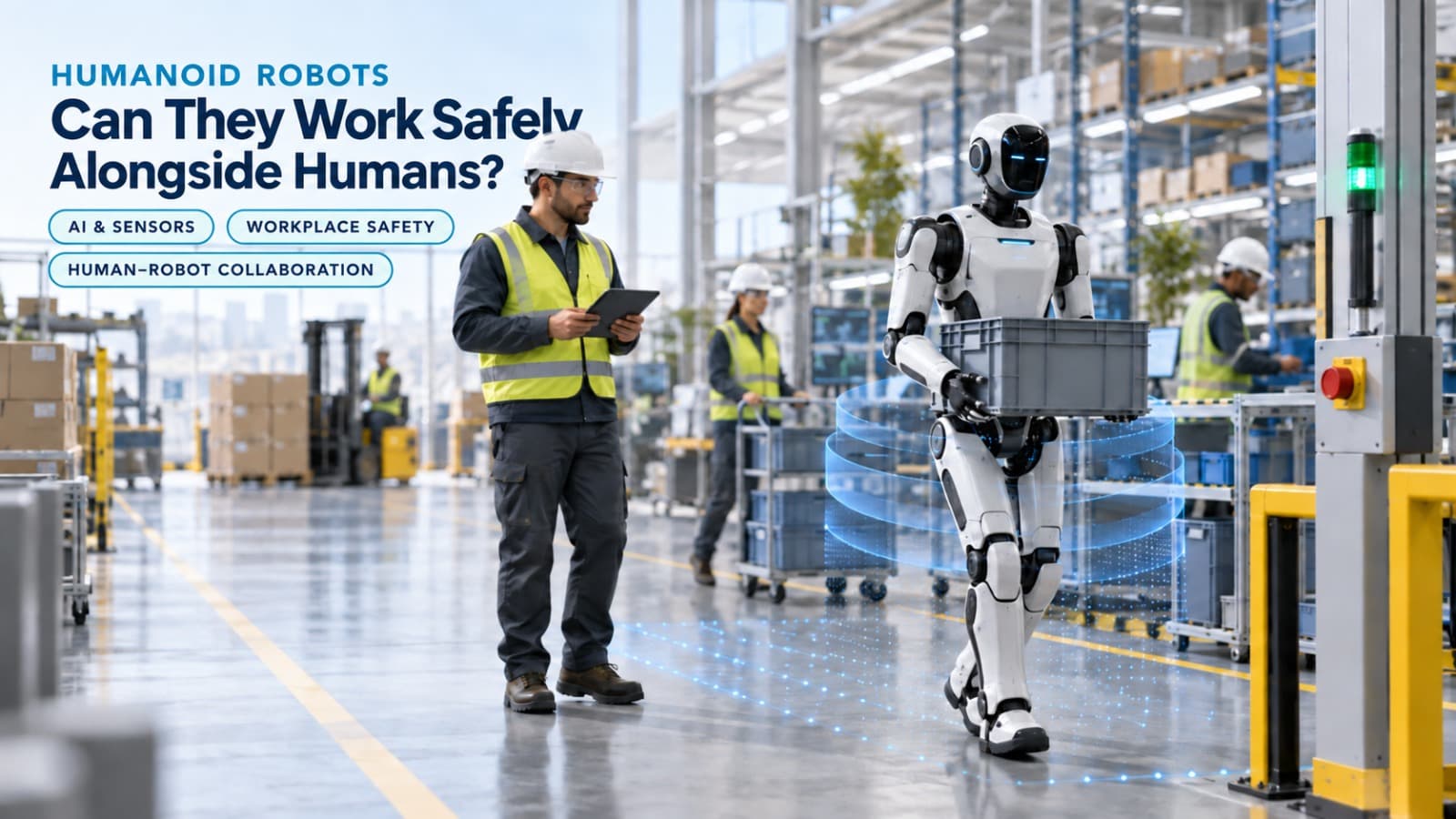
Humanoid robots are taking on a growing role in manufacturing, warehousing, and research facilities. These versatile, adaptive machines can walk, lift, and carry, as well as follow directions and complete physical tasks in worksites designed for humans.
Companies are pouring resources into the development of humanoid robots, including Agility Robotics (Digit), Tesla (Optimus), Boston Dynamics (Atlas), Figure (humanoid + Helix AI), and China's numerous robot manufacturers.
As video of humanoid robots doing backflips and walking basketball courts has gone virally popular, the question of safety has followed closely behind. Can humanoid robots work safely alongside humans?
The short answer is yes — but with important limitations and qualifications. Robots need more than just AI to allow them to work safely alongside humans. They also require advanced sensors, controlled motion, mechanical safety features, emergency systems, cybersecurity, and other factors. The most important consideration is that getting a humanoid robot to perform one remarkable feat isn't as important as ensuring that it performs thousands of ordinary tasks safely.
What Is a Humanoid Robot?
A humanoid robot is a machine that mimics the human form, using its torso, two legs, and two arms to move and operate in the world. Some humanoid robots use wheels instead of legs, and others may include specialized heads or robotic hands.
The human-like design is actually a significant advantage. Consider that doors, stairs, and workbenches are designed with humans in mind. A robot that can navigate and operate in the same space without requiring renovations to the facility is an enormous benefit.
A typical modern humanoid robot includes cameras, depth sensors, LIDAR, microphones, and/or other sensors, plus electric joints, batteries, an AI processor, computers, wireless communications, and safety systems to allow it to move, perceive its environment, and complete tasks.
Humanoid robots are part of the broader category of physical AI or embodied AI. Traditional AI methods typically process information inside a computer. Physical AI sends information to, and receives information from, a machine that can move in the real world. This distinction is critically important: a chatbot that delivers incorrect information is one thing, but a physical robot that incorrectly follows instructions or misjudges the environment can lead to far more serious errors.
Why Are Companies Developing Humanoid Robots?
Industrial robots are nothing new; manufacturers have used robotic arms for welding, painting, assembling, and moving parts for decades. These traditional industrial robots provide incredible value, flexibility, and productivity. However, they are typically large, robust, and stationary, often limited to a single task or set of tasks.
By contrast, a humanoid robot can be more flexible, able to complete multiple tasks in the same day. Imagine a robot that could carry parts from one room to another in the morning, deliver components to a manufacturing cell in the afternoon, and help with inventory management in the evening. That versatility is extremely valuable.
A company might be interested in using a humanoid robot for:
- Repetitive, tedious tasks
- Tasks that are physically demanding or ergonomically poor for humans
- Tasks that are difficult to mechanize
- Tasks that require navigating worksites with stairs or doorways
- Tasks that are spread out or require long travel
- Tasks that are better than alternative options such as a fixed-position industrial robot or a wheeled mobile robot It's also important to keep in mind that a humanoid robot is not always the best option. Some tasks are better suited to a conveyor belt, a traditional industrial robot, or even a wheeled mobile robot. The value of a humanoid robot is in its ability to perform multiple tasks using equipment that is already installed in the facility.
Latest Developments: Digit 5 Aims to Be a Cooperatively Safe Humanoid Robot
One of the most significant announcements in recent years occurred on September 15, 2026, when Agility Robotics unveiled Digit 5, the latest iteration of its industrial humanoid robot. Digit is designed to work in factories and logistics facilities, and Agility claims that its prior versions have already performed more than 65,000 hours of work for companies such as Amazon, GXO, Schaeffler, and Toyota Motor Manufacturing Canada.
Most notably, Agility announced that Digit 5 is a cooperatively safe humanoid robot that can recognize when a human is approaching and respond by slowing down, stopping, or even powering down.
Earlier versions of Digit and most other humanoid robots used a different approach to safety: keep people and robots separated as much as possible. That can be effective but limits the potential value of the robot. By contrast, Digit 5 and similar projects aim to allow humans and robots to work more closely and safely together.
Agility also announced that Digit 5 will likely have improved strength, interchangeable hands, and other features to make it more valuable in an industrial setting.
It is also worth noting that this is not a finalized product. Agility explicitly stated that Digit 5 is still under development, and its ultimate specifications and safety features are not yet complete. More importantly, they recognize that safety technology cannot make a robot completely safe. Reviewers should also remember that this is primarily a demonstration of potential: while Digit 5 has made tremendous strides in safety technology, its ultimate capabilities and safety record will be defined by its real-world performance after months or years of operation in a manufacturing or logistics facility.
More information on Digit 5 can be found on Agility Robotics' website.
How Can a Humanoid Robot Recognize Humans?
A humanoid robot cannot avoid collisions, limbs, or equipment unless it can sense them. Modern robots use a combination of vision, depth perception, and other sensors to allow the robot to identify and avoid humans and other objects in its workspace.
Cameras and Computer Vision
Cameras allow the robot to see the world, and computer vision lets it identify and track objects. Computer vision can recognize when a human is approaching the robot or when objects are moving in unexpected ways. Computer vision can also be used to identify objects, such as where a particular item is located, whether a piece of equipment is functioning, or whether a doorway or passageway is clear. Many vision systems use AI to make these calculations faster and more accurate.
However, a robot's computer vision is only as good as its camera — and cameras can sometimes have issues seeing objects clearly due to lighting, dust, reflective surfaces, unusual colors, or other factors.
Depth Cameras and LiDAR
Standard cameras register images in two dimensions, capturing the color and texture of what the camera is seeing. Depth cameras and LiDAR add a third dimension: depth. This allows the robot to gauge how far objects are, and whether the robot is in danger of running into something. In many cases, the robot can also estimate the speed and direction of moving objects.
Force and Torque Sensors
These sensors allow the robot to identify when a limb or joint is exerting force. This helps the robot to avoid applying too much force to a surface or object and allows it to identify when something is blocking its path. Torque sensors also play an important role in allowing the robot to grip objects of different weights without damaging them. A robot lifting a box is unlikely to need the same level of strength as a robot lifting a hunk of metal.
Joint and Motor Feedback
The robot's computer tracks the movement of individual joints and the electricity flowing through its electric motors. An unexpected change in amperage or position can indicate that the robot is encountering an issue, such as hitting an obstacle or slipping.
Redundancy: Multiple Sensors
A single camera can malfunction at any time, and vision-based systems can struggle in low light or other conditions. For this reason, safe robots use a combination of vision, depth perception, and other sensors. This allows the robot to operate even if one system is obstructed or fails. If a camera is temporarily blinded, for instance, the robot might use its depth sensors to avoid objects.
The same principle applies to many other technologies: if one system is disabled, the robot should still be able to perform its primary safety functions.
How Can a Humanoid Robot Work Safely Alongside Humans?
A robot's ability to avoid crashes, entanglement, and other dangers is critically important, but these safety technologies are only part of the equation. There are additional steps a company can take to ensure that a humanoid robot works safely alongside humans.
1. Mechanical Design: Avoid Dangerous Movement
A robot's power and speed are valuable, but they also constitute significant safety risks if something goes wrong. Mechanical design should be optimized to reduce the likelihood and severity of errors. This might include limiting the robot's movements to prevent it from leaning too far backward and falling over, for instance.
Robots should also have limited speed and reduced torque to prevent them from colliding with people at high speed or exerting dangerous pressure on the environment. Some tasks require a humanoid robot to be heavier in order to operate effectively. However, an overly heavy robot creates new safety concerns that must be addressed during the design process.
2. Speed and Separation: Maintain a Safe Distance
A humanoid robot can sense the presence of nearby humans and slow down or stop to avoid collision. When considering the placement of a robot in the workplace, a manager should calculate the shortest safe distance between the robot and other workers, and how far the robot can travel at various speeds before it needs to slow down or come to a complete stop.
The required distance will be impacted by:
- The robot's speed capabilities
- The robot's braking ability
- The speed with which a human can approach the robot
- The robot's weight and the weight of its cargo
- The accuracy of the robot's sensors
- The floor surface
- The location and placement of walls, equipment, and other furniture
3. Power and Force Limitations: Limit the Robot's Strength
Many collaborative robots use limited power, reducing the risk that the robot will apply excessive force to a person or object. However, limited power is not a guarantee of safety: a robot that carries a dangerous object can still be dangerous even if it moves slowly. Collaborative robots should have their maximum forces identified and limited, but companies should also evaluate how those forces interact with the robot's capabilities and the environment.
4. Emergency Stop: Allow People to Stop the Robot
An emergency stop function lets workers stop a robot if it begins behaving unpredictably or erratically. Emergency stop buttons or switches can be placed on the robot itself, on a control panel, or on an external device that communicates with the robot.
Companies should also consider what the robot does once it has been stopped. For instance, if a robot is holding an object when it stops, is there a risk that the object will be dropped?
5. Restricted Maintenance: Limit Access to Risky Functions
Some robots offer special modes that are useful for maintenance and repair, but these modes can also be dangerous if not used correctly. Maintenance or repair functions should only be accessible to authorized personnel, and even then, they should provide limited capabilities that reduce the risks of injury.
6. Health and Safety: Ongoing Diagnostics
The robot should use its sensors, computer vision, and other tools to continuously monitor its own health and safety. If a system warning or error occurs, the robot should enter a safe state to minimize the risks to humans and equipment. For instance, if the robot loses vision due to a camera malfunction, it should not assume that its path is clear when in fact it is not.
7. Human Supervision: Ensure Proper Oversight
A robot is only as safe as the people managing it. Individuals should understand a robot's lights, warnings, sounds, and other notifications. Supervisory staff should use fleet management software to track the robot's progress, location, battery power, safety status, and other key factors.
How Can a Robot's Artificial Intelligence Contribute to Its Safety?
Artificial intelligence can help robots to learn, adapt, and perform physical and mental tasks. However, a robot's AI is not inherently safe. An AI model that makes errors can cause the robot to make errors — and cause potentially dangerous mistakes.
Safety-critical functions should never rely on a single AI model. Instead, AI should be used to help the robot to recognize objects, receive and act on instruction, and make decisions. At the same time, a second system should be used to prioritize safety.
A helpful rule of thumb is that you can trust an AI to make decisions about what a robot should try to do, but you should not trust the same AI to decide how a robot should physically accomplish a task. This caution is especially important for robots that make decisions based on high-level reasoning. A robot's AI might decide that it wants to deliver a package to a specific location, but a second, more conservative system should be making decisions about how to get there and what to do if it encounters obstacles along the way.
A key consideration for robot safety is that an AI model will make mistakes. A robot should be tested for behaviors that can arise from poor AI performance, including:
- Incorrect object identification
- Errors in received instructions
- Mistaken movements
- Poor communication with other robots or systems A robot can be programmed to recognize and respond to specific dangers, but it is much harder to prepare it for edge cases and "unexpected" events. Robots should be trained to respond to rare but potentially dangerous events while also minimizing the risks of "normal" events such as a person walking by the robot.
Simulations can help a robot to learn about the world, but they cannot replicate the complexity of reality. Testing and validation in actual conditions are critically important, especially for robots that operate in complex, unpredictable environments.
What Standards Apply to Robot Safety?
Robots should follow established safety standards, undergo independent testing and evaluation, and be thoroughly documented — not just rely on the assurances of manufacturers.
The ISO 10218 standard covers the safety of industrial robots and their systems, and ISO 13482 addresses the safety of robots used in personal care. Other standards may also apply, depending on the robot, the environment, and the tasks it is designed to perform.
Humanoid robots are a special case, since they often include elements of industrial robots, collaborative robots, and mobile robots. They tend to be able to move, manipulate objects, and navigate the world in ways that none of these categories could on their own.
In April 2026, the United States National Institute of Standards and Technology (NIST) announced the development of a baseline performance benchmark for humanoid robots. This benchmark covers core competencies such as mobility, dexterity, locomotion, whole-body control, and basic reasoning. NIST hopes to establish common, standardized tests to determine a humanoid robot's capabilities.
This is critically important: robot demonstrations can be compelling, but they rarely tell the whole story. The NIST humanoid robot benchmark is part of a larger push toward independent, standardized evaluations of robot technology. NIST has also released a report focusing on robot perception, contact safety, and human-robot interaction.
Independent robot testing will become increasingly important as humanoid robots enter the marketplace. Customers will need more than just statements from manufacturers about robot capabilities and safety. They will seek concrete, objective evidence that a robot can perform specific tasks reliably and safely.
What Are the Risks and Limitations of a Humanoid Robot?
Unfortunately, no robot is completely safe. A humanoid robot can potentially fall, injure people, and damage property. The likelihood of these events occurring is low in most cases, but they are always a possibility.
A robot has inherent limitations in its ability to perceive and react to its environment. Sensors can fail, instructions can be misunderstood, and a machine can continue to operate even when it senses an issue.
At the same time, humans are also subject to errors and unpredictable behavior. Workers can enter a robot's workspace inappropriately, leave dangerous objects near a robot, or fail to follow basic safety guidelines. A company should always take human behaviors into account when designing a collaborative robot system.
A robot can also be hacked, and network access should be carefully monitored to prevent unauthorized access and tampering. Robots that use cameras and microphones can raise privacy concerns, particularly if they are used to monitor or record employees. A company must consider its legal obligations when it comes to employee privacy and adhere to relevant regulations.
Finally, a company should evaluate its own policies and behaviors. Can employees become complacent around a robot? How will they react to a malfunctioning robot? A robot can be incredibly valuable, and that can lead to overconfidence and unsafe behaviors around the machine.
Can Robots Make the Workplace Safer?
Collaborative robots can reduce the number of accidents and injuries in the workplace. However, this is not guaranteed — it depends largely on implementation.
Robots can take on repetitive tasks that are physically demanding or hazardous, reducing the number of injuries related to these tasks. A robot can complete inspections more frequently than a human worker. It can also help identify dangerous conditions or safety risks that might be overlooked by humans in the haste to get work done.
Robots can help reduce the risks that come with repetitive tasks, and they can also help human supervisors to perform their jobs more safely.
Research published by the International Federation of Robotics suggests that robots can contribute to a reduction in workplace injuries and fatalities. However, robots must be properly utilized for this benefit to occur.
A robot is not just an additional tool, but a significant change to a workplace. Proper training and procedures are critically important. Workplaces should never adopt a robot just because it is a robot. Instead, they should consider each task and ask themselves if the robot is the best option for that specific application.
Robots are most effective at repetitive, predictable tasks. They are less valuable for tasks that require human intuition or adaptability. However, even as robots take on more functions, they are likely to require human oversight and assistance.
Will Robots Replace Human Workers?
A robot can certainly replace human workers for specific tasks. However, it is much harder to eliminate an entire class of jobs. Most workers perform a variety of tasks, and a collaborative robot is likely to take on only part of their workload.
Even if a robot can complete a specific task, workers are still needed to ensure the task is performed correctly. A robot might carry materials, but a human still needs to inspect those materials.
Humanoids have the potential to create entirely new jobs, such as robot operation and supervision, robot maintenance, safety engineering, AI training, and more. The transition will be complicated, and employers, employees, educators, and policymakers all have roles to play in determining how work will be handled in the future.
Other Leading Humanoid Robot Programs
Agility Robotics is not the only company working on humanoid robots, of course. Boston Dynamics is also developing the electric Atlas for industrial applications, while Tesla has announced plans for the Optimus humanoid robot to perform "repetitive or dangerous tasks." Figure is combining its humanoid platform with the Helix AI, and numerous Chinese companies are working on a variety of robotic technologies.
These programs are at various stages of development, and their announcements, demonstrations, and production goals should all be taken with a degree of skepticism. The industry needs reliable information about robot performance, safety, costs, and other factors before it can make truly informed decisions about adoption.
The company that dominates the market for humanoid robots is likely to be the one that gets the most practical use out of its technology — not necessarily the company that can make the most compelling marketing claims. A robot's ability to perform everyday tasks safely and reliably will be critically important to its long-term success.
Final Thoughts: Can Humanoid Robots Work Safely Alongside Humans?
Humanoid robots can be safe, but it takes effort to ensure that they are. A robot needs reliable perception, controlled motion, power limitations, emergency systems, cybersecurity, and other factors to reduce the risk of injury or damage. At the same time, a responsible company will analyze the robot's role in the workplace, making sure it is the best option for the intended tasks.
Digit 5 and other programs show that the robot industry is preparing for the possibility of close human-robot interactions. However, even the manufacturers acknowledge that safety features can only do so much. Human-robot collaboration will likely be limited at first, carefully confined to specific applications where the risks are well understood.
Robots do not need to be perfect to be safe and useful; they just need to be reliable enough to operate in the real world alongside other people. Humans will learn to work more closely with robots in the future just as we have done with cars, computers, and other technologies. It will be interesting to see how this process unfolds over the coming years.
FAQ
Are humanoid robots safe? Humanoid robots can be safe when they are correctly designed, tested, and deployed for a specific application. They should include numerous features and technologies to help keep workers safe, but no robot is completely safe. A robot's safety depends on its design, programming, and the environment in which it operates. A well-designed robot can keep humans safe, but even the best technology can fail. A company should always conduct a thorough risk assessment before using a robot and should continue to evaluate the technology for potential issues even after deployment. Robots can also create new risks, such as a cybersecurity breach or privacy violations if the robot includes cameras or microphones. A company should consider the ethical implications of using a robot as well.
How can humanoid robots be made safe? Humanoid robots can be made safe by using reliable and safe technology as well as comprehensive oversight, training, and procedures. A robot should have features and technologies that help keep humans safe, such as visual and depth perception, speed limits, limited power, emergency stops, and more. However, even the safest robot can be dangerous if not managed responsibly. A company needs to consider the robot's role and safety profile as well as the human factor when determining how to keep everyone safe.
Can robots make the workplace safer? Robots can make the workplace safer by reducing the number of injuries and risks that come with certain tasks. They can take over physically demanding, repetitive processes while also completing more specialized tasks such as inspections and quality control. However, robots should be considered as part of the workplace rather than an alternative to human workers. A company should always take steps to ensure that a robot is used responsibly and safely.
Will robots replace human workers? A robot can replace human workers for specific tasks, but it is unlikely to eliminate an entire category of jobs. Most jobs include a variety of tasks, and a robot is likely to be useful for only some of them. In some cases, a robot can help to reduce the risks for human workers, keeping them safe while also completing repetitive processes. A robot can create new jobs, such as robot operation and maintenance, but it will also require humans to manage, maintain, and oversee its operation.